

How Strong is Pool Chlorine? Understanding Available Chlorine Content (ACC) in Pool Chemistry
A Key Concept in Certified Pool Operator (CPO) Training
One of the most misunderstood concepts in swimming pool chemistry is Available Chlorine Content (ACC). Pool operators frequently assume that the percentage listed on a chlorine product label indicates how much chlorine is actually in the container. In reality, Available Chlorine Content is a comparative measurement of oxidizing power, not a direct measurement of chlorine mass.
The concept originated in early industrial sanitation chemistry of the early twentieth century, when chlorine compounds were compared with chlorine gas (Cl₂), which was assigned a reference value of 100 percent available chlorine. The ACC of any chlorine compound simply indicates how effective that compound is relative to chlorine gas in terms of disinfecting and bleaching. This convention is still used today in water treatment chemistry and is widely discussed in academic literature on chlorine chemistry and oxidation reactions (White, Handbook of Chlorination and Alternative Disinfectants; Gordon et al., water treatment research published through academic institutions and ResearchGate).
For pool operators studying water chemistry in Certified Pool Operator (CPO) classes, understanding this distinction is critical. The percentage listed as Available Chlorine Content does not indicate how much chlorine is physically present in the container, but rather how strong that compound is as an oxidizer compared to chlorine gas.
To determine the actual amount of the active ingredient inside a container, we must instead examine the Percent Active Strength listed on the label.
Trichlor: A Stabilized Chlorine Compound
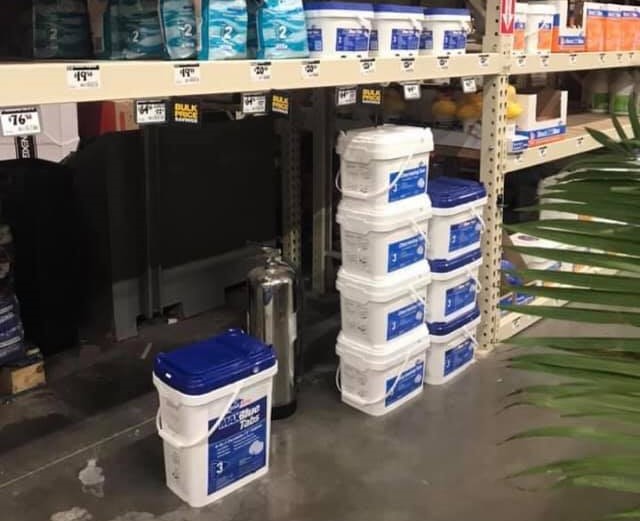
A common example is trichloro-s-triazinetrione (Trichlor), widely used in commercial and residential pools in tablet or granular form.
The chemical formula for trichlor is:
C₃Cl₃N₃O₃
Trichlor has an Available Chlorine Content of approximately 90%, meaning it is 90% as strong as chlorine gas as an oxidizing disinfectant.
Importantly, this 90% value applies to all trichlor products because it reflects the compound’s inherent chemistry rather than the amount of product in a container.
Most commercial trichlor products are also labeled greater than 99% active strength, meaning that nearly the entire contents of the bucket consist of trichloro-s-triazinetrione itself.
Understanding this difference is a core concept taught in Certified Pool Operator certification training, because misinterpreting ACC can lead to incorrect dosage calculations and improper sanitation levels in commercial pools.
Tablet Manufacturing and the “Gummy Residue” Myth
Modern chlorine tablets are manufactured using high-pressure compression equipment, rather than chemical binders. In earlier decades, binders such as xanthan gum were occasionally used to maintain tablet structure.
Today, however, most tablets rely solely on extreme mechanical pressure during manufacturing to form their solid shape.
Pool operators sometimes notice a gummy residue in erosion feeders or automatic chlorinators and assume tablets contain binders. In most cases, the residue is actually caused by zinc stearate, which is used as a manufacturing lubricant to prevent tablets from sticking to the compression molds.
Its function is similar to that of cooking spray, which prevents food from sticking to a skillet.
Stabilized Chlorine Adds Cyanuric Acid
Trichlor is also a stabilized chlorine compound, meaning it contains cyanuric acid (CYA) within its molecular structure.
Cyanuric acid has the formula:
C₃H₃N₃O₃
In trichlor, three hydrogen atoms in cyanuric acid are replaced by chlorine atoms:
C₃Cl₃N₃O₃
This chemical relationship explains why stabilized chlorine products increase cyanuric acid levels in pool water. Research on chlorine stabilization chemistry (Wojtowicz, O’Brien, and other water chemistry studies frequently cited in aquatic facility training) confirms that stabilized chlorines simultaneously introduce sanitizer and stabilizer into the water.
When 15 ounces of trichlor are added to 10,000 gallons of water, the result is approximately:
• 10 ppm Free Available Chlorine (FAC)
• 6 ppm Cyanuric Acid
• 10 ppm increase in Total Dissolved Solids
Trichlor is also acidic, with a pH near 3.0, meaning regular use will gradually lower pool pH and total alkalinity.
Another important operational advantage is shelf stability. Trichlor can maintain its Available Chlorine Content indefinitely when stored properly, making it one of the most stable chlorine compounds used in pool sanitation.
Sodium Hypochlorite (Liquid Chlorine)
Another widely used sanitizer is sodium hypochlorite (NaOCl), commonly referred to as liquid chlorine or pool bleach.
Commercial liquid chlorine typically contains 10–12 percent available chlorine by volume, referred to as Trade %. The remainder of the solution is primarily saltwater.
One gallon of 12% sodium hypochlorite will raise the free chlorine level in 10,000 gallons of water by approximately 12 ppm.
However, unlike stabilized chlorine products, sodium hypochlorite has a limited shelf life. Academic research on hypochlorite stability shows that liquid chlorine slowly decomposes through reactions that form chlorate and oxygen, especially when exposed to heat or sunlight (Gordon & Adam, chlorine decomposition studies; ResearchGate publications on hypochlorite stability).
As a result, sodium hypochlorite can decline from 12% to approximately 8% available chlorine within weeks of manufacture, particularly in warm storage conditions.
Household bleach is typically sold at 5–6% available chlorine.
Contrary to common belief, sodium hypochlorite does not permanently raise pool pH. Although the product itself is alkaline, the chemical reactions that consume chlorine are acidic, which largely offsets the initial pH rise. This principle is discussed extensively in water treatment chemistry research and is covered in depth in Certified Pool Operator certification programs.
Calcium Hypochlorite (Cal-Hypo)
Calcium hypochlorite (Ca(ClO)₂) is another common pool sanitizer, typically manufactured with 48–72% Available Chlorine Content.
Unlike trichlor, calcium hypochlorite introduces calcium ions into the pool water. When 20 ounces of cal-hypo are added to 10,000 gallons, the result is approximately:
• 10 ppm Free Chlorine
• 8 ppm increase in Calcium Hardness
• 15 ppm increase in Total Dissolved Solids
Calcium hypochlorite has a relatively long shelf life, typically remaining stable for several years when stored properly. Research on hypochlorite salts indicates that degradation occurs more slowly than with liquid chlorine because the compound is stored in a dry crystalline form.
As with other hypochlorite compounds, cal-hypo temporarily raises pH due to its alkaline nature. However, the subsequent reactions that consume chlorine return the pH to its original level.
Understanding these chemical interactions is essential for maintaining proper water balance and sanitation in commercial aquatic facilities, which is why they are emphasized in professional CPO training programs and pool operator certification courses.
Why Pool Operators Must Understand Chlorine Chemistry
Misunderstanding Available Chlorine Content, trade percentages, and active strength can lead to incorrect dosing, poor sanitation, and health code violations in commercial pools.
For this reason, chlorine chemistry is a foundational topic in Certified Pool Operator (CPO) certification courses, where operators learn how different chlorine compounds behave, how they impact water balance, and how to calculate proper dosing for safe aquatic facility operation.
Professional training programs such as those offered through CPOClass.com focus not only on passing the certification exam but also on helping pool professionals understand the underlying science of disinfection chemistry, water balance, and pool safety.
When pool operators understand the chemistry behind chlorine compounds—how Available Chlorine Content works, how stabilizers affect water chemistry, and how different sanitizers influence pH and hardness—they are far better equipped to maintain safe, balanced, and compliant swimming pools.
Why Understanding Chlorine Chemistry Matters for Certified Pool Operators
Understanding the chemistry behind chlorine compounds, available chlorine content, stabilizers, and hypochlorite reactions is not just academic—it is essential for anyone responsible for operating a commercial swimming pool or aquatic facility. Pool operators must routinely calculate sanitizer dosage, evaluate disinfectant strength, monitor water balance, and maintain regulatory compliance with local health departments. Misunderstanding concepts such as Available Chlorine Content, trade percentage, or the chemical interactions between chlorine and cyanuric acid can lead to improper sanitation, equipment damage, or health code violations. Research in water treatment chemistry consistently shows that proper operator education plays a critical role in preventing recreational water illnesses and maintaining safe aquatic environments (White, 2010; Wojtowicz, widely cited in aquatic industry literature).
For this reason, many commercial aquatic facilities require staff to obtain Certified Pool Operator (CPO) certification through structured training programs. In professional CPO classes, pool operators learn how chlorine compounds behave in water, how to interpret chemical labels, how to calculate dosing accurately, and how sanitizer chemistry interacts with pH, alkalinity, and cyanuric acid. At www.cpoclass.com, Certified Pool Operator training focuses on helping pool professionals understand the science behind water treatment rather than simply memorizing exam material. When pool operators understand chlorine chemistry more deeply, they are better equipped to maintain safe swimming pools, comply with health department regulations, and protect public health.
References
White, G. C. (2010). Handbook of Chlorination and Alternative Disinfectants. Wiley.
Gordon, G., Adam, L., et al. Research on hypochlorite stability and chlorate formation in water treatment systems.
Wojtowicz, J. A. Studies on cyanuric acid stabilization of chlorine in swimming pools.
ResearchGate publications on chlorine chemistry, hypochlorite decomposition, and aquatic sanitation.