

A Professional Summary for Certified Pool Operators – Regulations & Guidelines
Executive Summary
Aquatic facility operations are not governed by a single rulebook. They function within a layered regulatory framework involving federal agencies, state and local authorities, standards organizations, and industry associations.
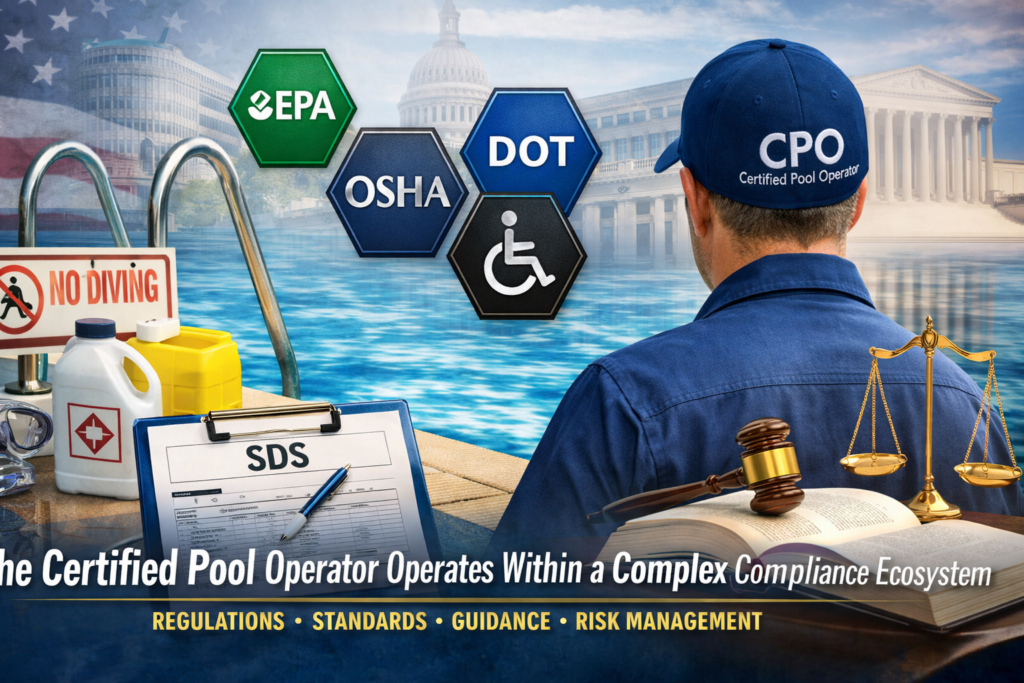
The Certified Pool Operator does not operate in isolation. The role exists within a structured compliance ecosystem that governs chemical usage, worker safety, transportation of hazardous materials, accessibility requirements, equipment performance standards, and public health guidance.
This bulletin clarifies:
- Which entities create enforceable law
- Which organizations publish standards that become enforceable when adopted
- Which bodies provide advisory guidance
- How these layers intersect operationally
Understanding the difference between regulation, adopted standards, and guidance is fundamental to defensible aquatic operations.
Core Principle
Aquatic facility compliance is multi-jurisdictional.
Certified Pool Operators must recognize that:
- Federal agencies regulate chemical labeling, worker safety, transportation, and disability access.
- State and local health departments enforce operational codes.
- Standards organizations publish equipment and safety specifications.
- Industry associations develop best-practice guidelines that often influence code development.
The professional operator must determine which requirements are legally binding and which serve as performance benchmarks.
Failure to make this distinction shifts compliance from structured management to assumption-based operation.
Federal Regulatory Agencies
Several federal entities directly influence aquatic facility operations.
Environmental Protection Agency (EPA)
The EPA regulates chemical registration, labeling, and environmental protection under FIFRA. Pool chemicals must be used strictly according to label directions. Labels carry legal authority and define:
- Permitted applications
- Dosage limitations
- Required safety precautions
- Hazard communication standards
Using chemicals inconsistently with labeling instructions is not a procedural error — it is a regulatory violation.
Occupational Safety & Health Administration (OSHA)
OSHA governs workplace safety. For aquatic facilities, this includes:
- Hazard Communication (HazCom) programs
- Safety Data Sheet (SDS) accessibility
- Chemical storage requirements
- Employee exposure prevention
- Emergency response planning
Operators must ensure employees are trained, documentation is retrievable, and chemical handling protocols are defensible.
Workplace safety compliance operates independently from water quality compliance.
Consumer Product Safety Commission (CPSC)
The CPSC focuses on consumer injury prevention. In aquatic environments, this intersects with:
- Suction entrapment hazards
- Drain safety compliance
- Product-related injury prevention
Failure in this area may create both regulatory and civil liability exposure.
Department of Transportation (DOT)
DOT regulates the transportation of hazardous materials in commerce under 49 CFR.
Pool service companies frequently transport:
- Sodium hypochlorite
- Calcium hypochlorite
- Muriatic acid
- Other oxidizers and corrosives
Whether DOT rules apply depends on:
- Hazard classification
- Quantity thresholds
- Packaging type
- Vehicle configuration
- Aggregate load weight
DOT compliance can require:
- Hazmat employee training
- Shipping papers
- Placarding
- USDOT registration
- CDL with HazMat endorsement
- Drug and alcohol testing programs
- Security plans
- Approved containers
Many operators incorrectly assume DOT rules apply only to freight carriers. Federal law regulates transportation of hazardous materials in commerce — not the size of the company.
Misinterpretation can result in:
- Civil penalties
- Operational shutdown
- Insurance exposure
- Heightened liability in the event of a spill or accident
The prudent position is documented verification of applicability — not assumption of exemption.
DOT Hazardous Materials Compliance Checklist
(Educational reference only; not all-inclusive. Consult current 49 CFR and state enforcement guidance.)
Operators transporting regulated chemicals should evaluate:
- Hazard classification and aggregate quantity calculations
- Hazmat employee training documentation and recurrent training intervals
- Shipping paper requirements and accessibility
- Vehicle marking and placarding thresholds
- DOT registration and USDOT number display
- CDL and HazMat endorsement applicability
- Drug and alcohol program requirements
- Container approval, hydrostatic test dates, and chemical segregation
Department of Justice — ADA Enforcement
The Americans with Disabilities Act establishes accessibility requirements for public accommodations.
Aquatic facilities fall under Title II (public entities) or Title III (public accommodations). Accessibility compliance is not optional and is not limited to new construction.
Application of the 2010 ADA Standards to Aquatic Facilities
The 2010 ADA Standards for Accessible Design govern swimming pools, wading pools, and spas. These standards became mandatory for newly constructed and altered facilities beginning March 15, 2012, and remain the controlling federal accessibility rule.
New Construction and Alterations
Facilities must comply with Sections 242 and 1009, which require:
- Prescribed number of accessible means of entry
- Specific lift or sloped-entry requirements
- Technical compliance with clear deck space, seat height, and operational criteria
Full compliance is expected unless a narrow exception applies.
Existing Facilities
Title III facilities must remove architectural barriers when removal is “readily achievable,” meaning easily accomplishable without significant difficulty or expense.
This determination is fact-specific and considers:
- Financial resources
- Operational impact
- Feasibility
The obligation is ongoing. Financial improvements may change what is considered readily achievable.
Enforcement Reality
ADA enforcement does not rely solely on inspections. It may occur through:
- Department of Justice enforcement
- Private civil litigation
Documentation of accessibility assessments and corrective action evaluations is a defensible risk management practice.
The Certified Pool Operator may not make structural decisions but must recognize accessibility gaps and communicate them to ownership or management.
Accessibility is a continuing legal obligation, not a construction afterthought.
Centers for Disease Control & Prevention (CDC)
The CDC publishes public health guidance, including the Model Aquatic Health Code (MAHC).
While MAHC is not federal law, it serves as a template adopted by many state and local jurisdictions. Once adopted into local code, MAHC provisions become enforceable.
Operators must monitor which MAHC provisions have been incorporated into their jurisdiction.
Standards & Consensus Organizations
Many operational expectations originate from standards bodies rather than regulatory agencies.
- International Code Council (ICC) — Model building codes
- World Health Organization (WHO) — International recreational water guidance
- Pool & Hot Tub Alliance (PHTA) — Industry standards and best practices
- The Chlorine Institute — Chemical handling and safety publications
- NSF International — Equipment and feeder certification
- ASTM International — Technical performance standards
- Underwriters Laboratories (UL) — Product safety certification
- National Fire Protection Association (NFPA) — Hazardous material and fire codes
- American Red Cross and other water safety organizations — Lifeguard and emergency training standards
When adopted into state or local code, these standards become enforceable.
Regulatory Hierarchy Clarified
Compliance obligations generally fall into three categories:
Law (Enforceable)
- Federal statutes
- State codes
- Local health department regulations
Standards (Enforceable When Adopted)
- ANSI
- ASTM
- NSF
- ICC
Guidance (Advisory but Influential)
- CDC MAHC
- WHO guidelines
- Industry best practices
Confusing these categories leads to inconsistent compliance decisions.
Operational Implications for the Certified Pool Operator
A Certified Pool Operator must:
- Verify chemical usage complies with EPA labeling
- Maintain OSHA-compliant SDS documentation
- Ensure equipment meets applicable NSF/ANSI standards
- Confirm ADA accessibility compliance where required
- Follow local health department code requirements
- Stay informed regarding adopted MAHC provisions
- Evaluate DOT applicability for transported chemicals
Compliance is not a checklist completed on inspection day. It is structured operational oversight.
Risk Management Considerations
Failure to distinguish between regulation, adopted standards, and advisory guidance may result in:
- Improper chemical application
- Inadequate employee safety procedures
- Accessibility litigation exposure
- Equipment installation violations
- Transportation compliance penalties
- Increased civil liability
The Certified Pool Operator functions as a risk manager within this regulatory structure.
Certification represents operational responsibility — not symbolic credentialing.
Key Takeaway
The Certified Pool Operator operates within a complex compliance ecosystem.
Competent operators:
- Understand regulatory jurisdiction
- Maintain required documentation
- Recognize when standards become enforceable
- Apply guidance proactively
- Anticipate risk rather than react to it
Certification is not simply knowledge of water chemistry.
It is disciplined navigation of regulatory structure.
Compliance is not accidental.
It is learned.
Join Live Virtual Certified Pool Operator (CPO) Training and gain the operational clarity regulators expect.
Register now at CPOClass.com.