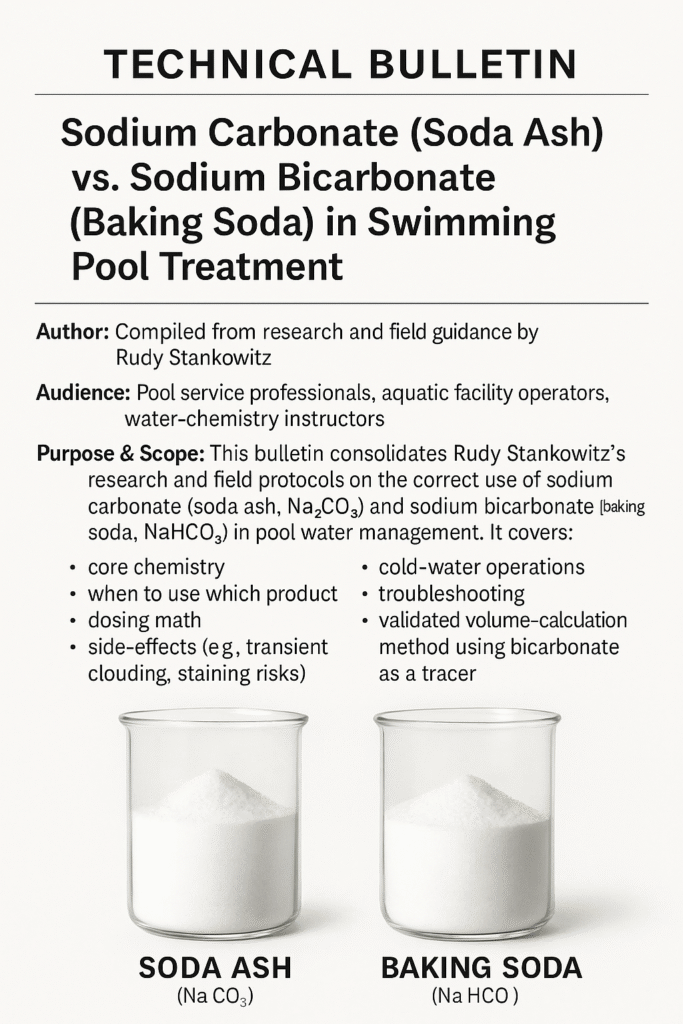


Sodium Carbonate (Soda Ash) vs. Sodium Bicarbonate (Baking Soda) in Swimming Pool Treatment
Author: Compiled from research and field guidance by Rudy Stankowitz
Purpose & Scope
This bulletin consolidates Rudy Stankowitz’s research and field protocols on the correct use of sodium carbonate (soda ash, Na₂CO₃) and sodium bicarbonate (baking soda, NaHCO₃) in pool water management. It covers: core chemistry, when to use which product, dosing math, side-effects (e.g., transient clouding, staining risks), sequencing with other chemicals, buffer strategy, cold-water operations, troubleshooting, and a validated volume-calculation method using bicarbonate as a tracer.
Executive Summary (Quick Guidance)
- Baking soda (NaHCO₃): Primary tool to raise Total Alkalinity (TA) with minimal pH lift.
- Soda ash (Na₂CO₃): Primary tool to raise pH (also raises TA).
- Do not co-dose near calcium products or strong oxidizers; expect temporary CaCO₃ haze if soda ash meets dissolved calcium. Filter clears it.
- Avoid large pH jumps in water with copper present; you can push Cu(OH)₂ out of solution (teal/blue haze or deposits).
- For stability, pair the native bicarbonate buffer with borates when appropriate.
- In cold water, dissolution slows; allow extended circulation and staggered additions.
Chemistry Primer (What Each Chemical Actually Does)
Carbonate System in Pools
Pool buffering is dominated by the carbonic acid/bicarbonate/carbonate system:
- CO₂(aq) ⇌ H₂CO₃ (carbonic acid) ⇌ HCO₃⁻ (bicarbonate) ⇌ CO₃²⁻ (carbonate)
Bicarbonate (NaHCO₃) adds HCO₃⁻, which increases TA (buffer capacity) with a small pH increase.
Soda ash (Na₂CO₃) adds CO₃²⁻, which consumes H⁺ and increases pH more strongly (and also increases TA).
Key Side Reaction With Calcium
When soda ash is added to water containing dissolved calcium (as Ca²⁺), it can form calcium carbonate:
- CO₃²⁻ + Ca²⁺ → CaCO₃(s) (filterable precipitate)
This is the classic “milky” or “cloudy” episode after soda ash dosing. Proper sequencing, dilution, and filtration resolve it.
When to Use Which (Decision Rules)
Use Baking Soda (NaHCO₃) when:
- TA is below target and pH is near-normal or only slightly low.
- You need to increase buffer capacity without overshooting pH.
- You are preparing a borate-bicarbonate buffer strategy for pH stability.
Use Soda Ash (Na₂CO₃) when:
- pH is low and needs efficient lift (e.g., after heavy acid use, rain dilution, or chronic CO₂ loading).
- TA is acceptable but you still need a pH correction. (Note: TA will rise; reassess after mixing.)
Avoid both in close time/space proximity to:
- Calcium chloride or calcium hypochlorite additions (clouding risk).
- Copper-bearing water where a sudden pH jump may cause Cu(OH)₂ precipitation.
Practical Dosing & Math
Field-Reliable Heuristics
- Baking Soda (NaHCO₃):
Roughly 1.4–1.5 lb per 10,000 gal → ~+10 ppm TA (with modest pH increase). - Soda Ash (Na₂CO₃):
pH rise depends on current TA/CO₂ state. As an operational approach, start small (e.g., 6–8 oz per 10,000 gal), circulate 30–60 min, then retest. Expect some TA increase with any pH correction.
Always test, dose in increments, circulate thoroughly, and re-test. Temperature, aeration, current TA, and CO₂ off-gassing all affect outcomes.
Worked Example — Raising TA with Baking Soda
Goal: Raise TA from 60 ppm to 90 ppm (ΔTA = +30 ppm) in a 20,000 gal pool.
Rule of thumb: 1.5 lb / 10k gal → +10 ppm TA.
- Needed “10-ppm steps”: 30/10 = 3 steps.
- Dose per 10k gal: 1.5 lb × 3 = 4.5 lb.
- Pool is 20k gal → 2 × 4.5 = 9.0 lb NaHCO₃ total.
Split into two additions (e.g., 5 lb, then 4 lb), circulate between, and re-test.
Worked Example — Raising pH with Soda Ash
Situation: pH 7.1, TA 80 ppm, 15,000 gal.
Start with ~6 oz soda ash per 10k gal → ~9 oz initial dose. Circulate 45–60 min.
Re-test pH. If still low, repeat small increments. Verify TA drift and watch for clouding; filter clears it.
Sequencing & Compatibility (Preventing Cloudy Water and Stains)
- Separate additions of soda ash or baking soda from calcium chloride and calcium hypochlorite by at least several hours (preferably a full turnover).
- Dose away from skimmers pre-feeding granular calcium or cal-hypo, and avoid the same day if the water is near LSI/CSI positive.
- Maintain good circulation during and after dosing.
- If copper is present (from heaters, algaecides, or source water), avoid large pH jumps with soda ash. Consider a sequestrant (and confirm filter and backwash schedule) before pH correction.
Transient Clouding: Mechanism & Response
Cause: Local carbonate from soda ash meets calcium → CaCO₃ micro-precipitate, which appears as a milky haze.
Response:
- Keep the pump running; maintain filtration.
- Do not stack new chemicals on top of the haze.
- Expect clarity recovery as filters capture precipitate; backwash/clean as needed.
- Verify pH/TA and re-balance gently.
Buffering Strategy (Bicarbonate + Borate)
For facilities seeking greater pH stability and reduced “yo-yo” dosing:
- Establish TA with bicarbonate in your normal target range.
- Add borates to ~30–50 ppm as borates (≈9–15 ppm as B). Check local code.”) to broaden the buffer system, helping resist rapid pH drift from aeration, bather load, and feed fluctuations.
- This approach reduces chasing pH and can smooth out the need for frequent acid/base swings.
Always confirm local code allowances for borates and label instructions for the borate product in use.
Cold-Water Operations (Plunge Pools, Off-Season)
- Dissolution and reaction kinetics slow significantly below ~60 °F.
- Use smaller, staged doses, allow longer circulation time between tests.
- Expect delayed pH/TA response; be patient and verify before re-dosing.
Volume Calculation by Bicarbonate Tracer (Pro Method)
When the true gallonage of a pool is uncertain, you can determine it chemically by using sodium bicarbonate (NaHCO₃) as a tracer. This method relies on measuring the precise change in Total Alkalinity (TA) caused by a known mass of added bicarbonate.
Principle
Each mole of bicarbonate ion (HCO₃⁻) contributes one equivalent of alkalinity, expressed as mg/L as CaCO₃. The relationship between the added dose and the measured TA increase is:


where:
mNaHCO₃= mass of sodium bicarbonate added (grams)
VL= pool volume in liters
Rearranging for volume in gallons gives:


where:
where:
- = mass of sodium bicarbonate added (grams)
- = pool volume in liters
Example
If 5.0 lb of NaHCO₃ produces a 12 ppm rise in TA:
Vgal=1271,325×5.0≈29,700 gallons
This back-calculated volume provides a practical verification against nameplate data or estimator charts.
Field Protocol
- Record the baseline TA.
- Add a measured quantity (typically 4–6 lb) of NaHCO₃ evenly across the deep end.
- Circulate for at least 1–2 hours, or one full turnover for large or complex systems.
- Re-test TA using the same test method and endpoint as the initial reading.
- Compute volume using the formula above.
- Verify the result against dimensional estimates for consistency.
Notes & Best Practices
- Maintain strong circulation during and after dosing for full dispersion.
- For cold or stratified water, extend mix time before testing.
- Repeat with a second, smaller dose if the TA change is <10 ppm for better accuracy.
- Always log the dose mass, TA readings, and calculated result for traceability.
Safety, Handling, and Application Technique
- Personal protection: Gloves, eye protection, and dust control (especially for soda ash, which is more alkaline).
- Addition point: Broadcast into the deep end with strong circulation; avoid dumping into skimmers that feed chemical feeders directly downstream.
- Pre-dissolution: Optional for baking soda. For soda ash, pre-slurry in a bucket to limit local hot spots and reduce scale formation at the point of contact.
- Spacing: Leave several hours to a full turnover between carbonate additions and calcium or high-pH oxidizer additions (cal-hypo).
- Retesting: Always confirm pH, TA, and clarity before proceeding with additional chemicals.
Troubleshooting Guide
- A) pH too low, TA ok-to-low?
- Use soda ash first to correct pH; reassess TA. If TA remains low, finish with baking soda.
- B) TA low, pH normal?
- Use baking soda to bring TA to target; pH change should be modest.
- C) Added soda ash → water turned milky?
- Keep filtration running; expect CaCO₃ haze to clear. Backwash/clean filter; avoid adding calcium products until clear.
- D) Turquoise/teal tint or staining after pH correction?
- Suspect copper. Bring pH back down into recommended range (if safe), sequester, and review heater/source water. Avoid large pH jumps next time.
- E) Cold water, no response to dose?
- Extend mix time, use smaller increments, and re-test after longer circulation.
FAQs & Field Notes
- “Can I raise TA and pH at once with soda ash?”
You can—but you’ll raise TA whether you intend to or not, and you risk clouding. If the real goal is TA, use baking soda. - “Why did pH rise after I added nothing but air?”
Aeration/CO₂ off-gassing raises pH without increasing TA. Don’t “chase” that with unnecessary chemicals; tune aeration and verify TA. - “How much baking soda is too much at once?”
Large single slugs can cause localized high TA and small dust clouds. Stage doses, circulate, and re-test. - “Can I use these with borates?”
Yes. Set TA with bicarbonate, then add borate per label for stability. Always check local code.
Field Case Snapshots (Representative)
- Cloudy After Soda Ash, Cleared by Filtration:
Operator raised pH from 7.0 to ~7.5 in a 25k-gal pool with soda ash; transient haze formed, cleared after 12 hours of continuous filtration and one backwash. Final pH 7.5, TA +8 ppm—no drain, no floc. - Copper Tint Triggered by Sudden pH Jump:
Facility with aged copper heat-exchanger shocked pH upward with a heavy soda ash dose. Water turned light teal; resolved with pH normalization and sequestrant, then gentler pH adjustments. - TA Rebuild with Bicarbonate, Minimal pH Movement:
50-meter pool at TA 50 ppm, pH 7.5. Staged NaHCO₃ doses over two turnovers brought TA to 90 ppm with pH ~7.6. Stability improved; acid demand evened out.
Quality Control Checklist (Use Each Visit)
- Test pH, TA, CH, temperature, TDS, and observe clarity.
- Confirm goal (pH correction vs. TA rebuild).
- If using soda ash, verify no recent or upcoming calcium additions.
- Dose in increments, circulate, and re-test.
- Document amounts, times, and post-dose readings.
- If clouding occurs, maintain filtration; plan for backwash/clean.
- Re-balance and log final values.
Key Takeaways
- NaHCO₃ → TA up, small pH up.
- Na₂CO₃ → pH up (and TA up), clouding risk with calcium.
- Sequence matters; never stack with calcium products or cal-hypo.
- Watch copper when making big pH moves.
- For steadier water, think borate + bicarbonate buffer.
- In cold water, slow down and re-test later.
- Use the bicarb tracer to verify pool gallons.
Here are the source URLs for the Rudy Stankowitz research and articles pulled into the Technical Bulletin. These are the direct references where soda ash (sodium carbonate) and baking soda (sodium bicarbonate) are discussed in pool treatment:
- Soda Ash vs. Baking Soda – Pool & Spa News
https://www.poolspanews.com/business/chemistry/soda-ash-vs-baking-soda_o - How to Clear Cloudy Pool Water Fast – CPOClass
https://cpoclass.com/cloudy-pool-water - Lowering Total Alkalinity Without Affecting pH – CPOClass
https://cpoclass.com/lowering-total-alkalinity-without-affecting-ph - How to Fix Milky Pool Water Without Draining – AQUA Magazine
https://www.aquamagazine.com/how-to-fix-milky-pool-water - Raising pH with Air (Aeration vs. Bicarbonate) – CPOClass
https://cpoclass.com/raising-ph-with-air - Pool Acid Scarcity? Try a Borate-Bicarbonate Buffer – CPOClass
https://cpoclass.com/borate-bicarbonate-buffer - How Borates in Swimming Pools Buffer pH – CPOClass
https://cpoclass.com/borates-buffer-ph - Cold Plunge Pool Maintenance: Essential Tips – CPOClass
https://cpoclass.com/cold-plunge-pool-maintenance - Calculate Pool Gallons Chemically (Bicarb tracer method) – CPOClass
https://cpoclass.com/calculate-pool-gallons - Copper Stains in Swimming Pools – CPOClass
https://cpoclass.com/copper-stains - Baking Soda Pool Hack – Is It Real Or Is It Clickbait? – Pool Magazine
https://www.poolmagazine.com/features/baking-soda-pool-hack - pH Balance, pH Buffers, and Negotiation Strategies – CPOClass
https://cpoclass.com/ph-balance-ph-buffers - Pool Opening Checklist (baking soda use on covers) – CPOClass
https://cpoclass.com/pool-opening-checklist