
What We Actually Know About the Lincoln Memorial Reflecting Pool
Everybody has an opinion.
The internet decided what caused the Lincoln Memorial Reflecting Pool coating failure almost before the first photograph finished loading.
Some blamed vandalism.
Others blamed algae.
Some blamed the coating manufacturer.
Others blamed the contractor.
And because this is 2026, plenty of people somehow managed to blame politicians.
Here’s the problem.
None of those opinions are evidence.
I’ve spent more than thirty-five years troubleshooting swimming pools, water parks, commercial aquatic facilities, reservoirs, and decorative water features. One thing I’ve learned is that water doesn’t lie—but people do. Rumors spread. Social media rewards confidence instead of accuracy. Before long, everyone is convinced they know exactly what happened despite having never stepped foot on the project.
That’s backwards.
Real investigations don’t begin with conclusions.
They begin with questions.
Listen to this episode in its entirety here:
The Pool Everyone Thinks They Know
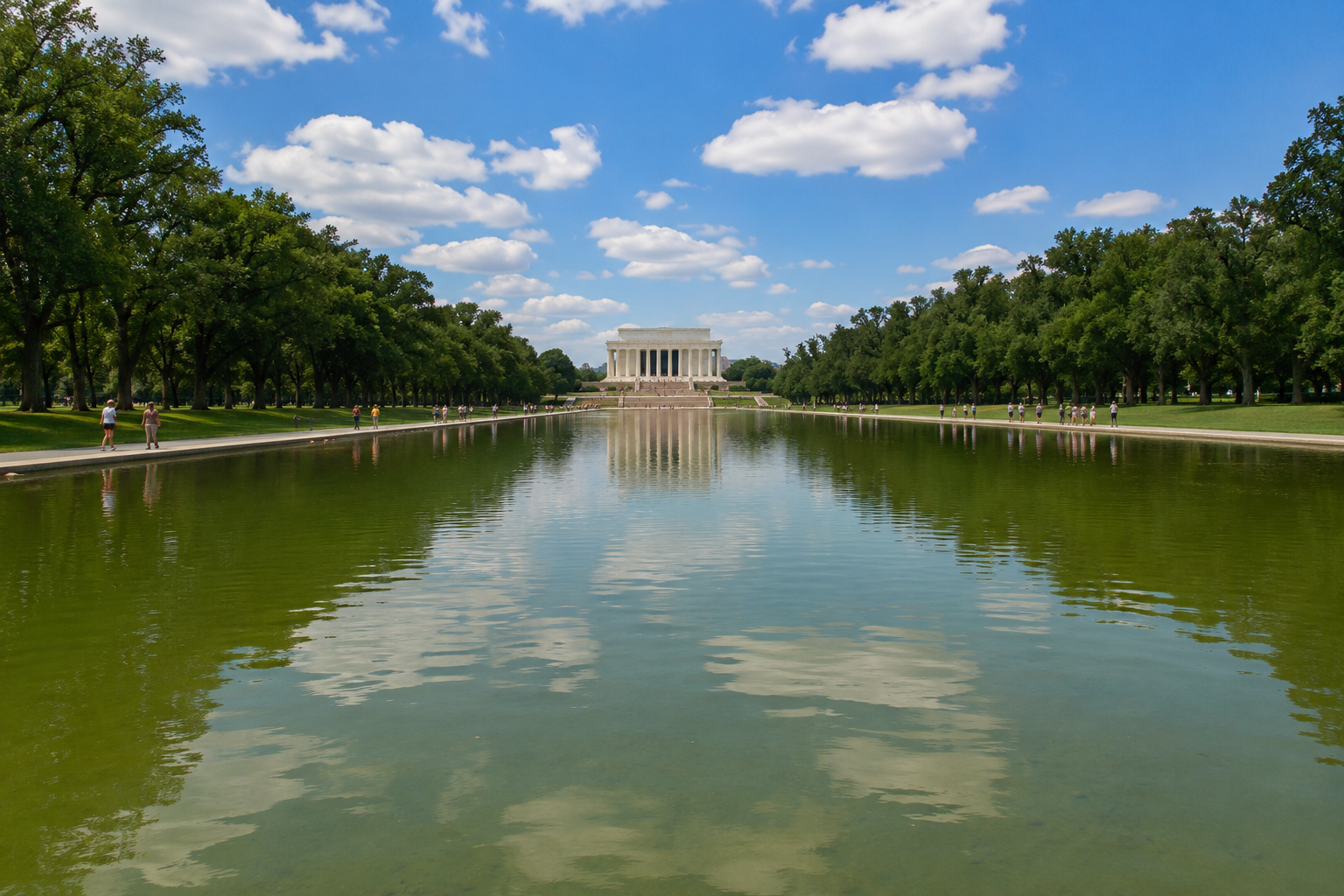
The Lincoln Memorial Reflecting Pool isn’t simply a decorative pond.
Completed in 1922, it stretches nearly 2,000 feet between the Lincoln Memorial and the Washington Monument and holds approximately 6.7 million gallons of water.
Pool professionals see something most visitors never consider.
Nearly fifty million pounds of water sitting on reclaimed wetlands.
Water has been trying to exploit every weakness in that structure for more than a century.
Around 2010 through 2012, the basin underwent extensive structural rehabilitation. Engineers stabilized the foundation, reconstructed portions of the basin, and upgraded the infrastructure beneath one of America’s most recognizable landmarks.
This wasn’t cosmetic work.
It was civil engineering on a massive scale.
Similar Article Pool Experts Say Lincoln Memorial Reflecting Pool Damage Wasn’t Vandalism
 The 2026 Renovation
Earlier this year, the National Park Service drained the basin and installed a new waterproofing system.
According to publicly available documentation, the system included an epoxy primer, waterproofing components, and a blue polyurea protective coating.
Polyurea isn’t unusual.
It’s widely used in reservoirs, wastewater treatment facilities, industrial containment systems, and other concrete structures that spend their lives under water.
Concrete isn’t waterproof.
Protective coating systems are designed to help it survive.
Then something happened.
The water turned green.
Large blue sheets of coating began floating across the surface.
Those two observations launched thousands of opinions.
Similar Story (3) The Free Press – The reflecting pool, nestled between the Lincoln… | Facebook
Facts Versus Assumptions
Let’s separate documented facts from theories.
According to the National Park Service:
- Foam sealant was reportedly cut with a sharp object.
- Approximately seventy fence-post caps were thrown into the basin.
- Delaminating coating material was observed.
- The pool was scheduled to be drained following Independence Day for inspection and repairs.
Those are facts.
What those facts do not establish is whether the vandalism caused the coating failure.
Those are two completely different questions.
An investigation exists to determine whether those events are connected—not to assume they are.
Why Coatings Fail
One mistake I keep seeing is people referring to the coating as though it were paint.
It isn’t.
This is an engineered coating system.
Each layer has a different job.
The primer bonds to the concrete.
The waterproofing layer protects the structure.
The polyurea provides the protective wearing surface.
When failures occur, investigators don’t simply ask whether the coating came off.
They ask where the system separated.
Was it:
- Adhesive failure?
- Cohesive failure?
- Substrate failure?
Those three failures can appear similar in photographs while having completely different causes.
That’s why photographs alone rarely solve coating failures.
Similar Story Reflect on Patriot Day: The 9/11 Memorial Pools
The Questions Nobody Can Answer Yet
Several important pieces of information remain unavailable publicly.
Where are the pull-off adhesion test results?
Where are the concrete moisture readings?
Where are the ASTM D4541 adhesion tests?
Were ASTM F2170 or ASTM F1869 concrete moisture tests performed?
What was the concrete surface profile before installation?
Were environmental conditions within specification?
Were dew-point calculations documented during application?
Were installation logs maintained?
Those aren’t minor details.
Those are precisely the documents forensic coating investigators use to determine why failures occur.
Without them, every conclusion remains speculation.
The Recoat Window
One publicly available technical document caught my attention.
Rhino’s technical literature indicates the elastomeric coating should generally be applied after approximately one hour and within twenty-four hours of the epoxy primer.
That matters.
Coatings continue curing after application.
Once that window expires, manufacturers often require additional surface preparation before the next layer is applied.
If that preparation doesn’t occur, adhesion problems can develop.
Does that prove it happened here?
Absolutely not.
It simply establishes one technically reasonable hypothesis that deserves investigation.
Good investigators don’t become emotionally attached to theories.
They try to eliminate them.
If evidence disproves the theory, you move on.
If evidence supports it, you continue testing.
That’s how engineering works.
Green Water Doesn’t Solve Anything
Another misconception is that the algae somehow explains everything.
It doesn’t.
The publicly identified organism was Desmodesmus, a common freshwater green algae.
Outdoor water bodies go green all the time.
Sunlight.
Birds.
Dust.
Organic debris.
Pollen.
Storm runoff.
Nutrients.
Nature constantly tries to reclaim open water.
Green water alone proves only one thing.
Algae grew.
It doesn’t prove sabotage.
It doesn’t prove poor maintenance.
It doesn’t prove coating failure.
Those may be entirely separate issues.
What I’d Investigate
If someone handed me this project tomorrow, I wouldn’t begin with a press conference.
I’d begin with evidence.
Every failed section would be mapped.
Every intact section documented.
Wall-to-floor transitions would receive particular attention because that’s where many publicly visible failures appear concentrated.
Then I’d begin testing.
Pull-off adhesion testing.
Core sampling.
Film thickness measurements.
Microscopic cross-sections.
Concrete moisture analysis.
Independent laboratory evaluation.
Only after all of that would I begin eliminating possible causes.
That’s slower than social media.
It’s also how you discover the truth.
Water Doesn’t Care About Politics
Some people desperately want this story to become political.
Water couldn’t care less.
Water doesn’t know who signed the contract.
It doesn’t know who held office.
It doesn’t care about headlines.
Physics.
Chemistry.
Materials science.
Those are the only languages water speaks.
That’s why I keep returning to ASTM standards, adhesion testing, moisture analysis, dew-point calculations, installation sequencing, and forensic evaluation.
Evidence doesn’t vote.
It simply tells the story.
The Lesson
This investigation isn’t really about one famous reflecting pool.
It’s about every coating system that will ever be installed after this one.
Every failure teaches something.
Every forensic investigation improves future projects.
But only if we let evidence lead instead of emotion.
Could my leading theory be wrong?
Absolutely.
In fact, I hope investigators prove or eliminate every reasonable possibility.
I don’t need my theory to win.
I need the evidence to win.
Because the next lesson learned here could prevent another multimillion-dollar failure somewhere else.
And that’s worth far more than winning an argument on the internet.