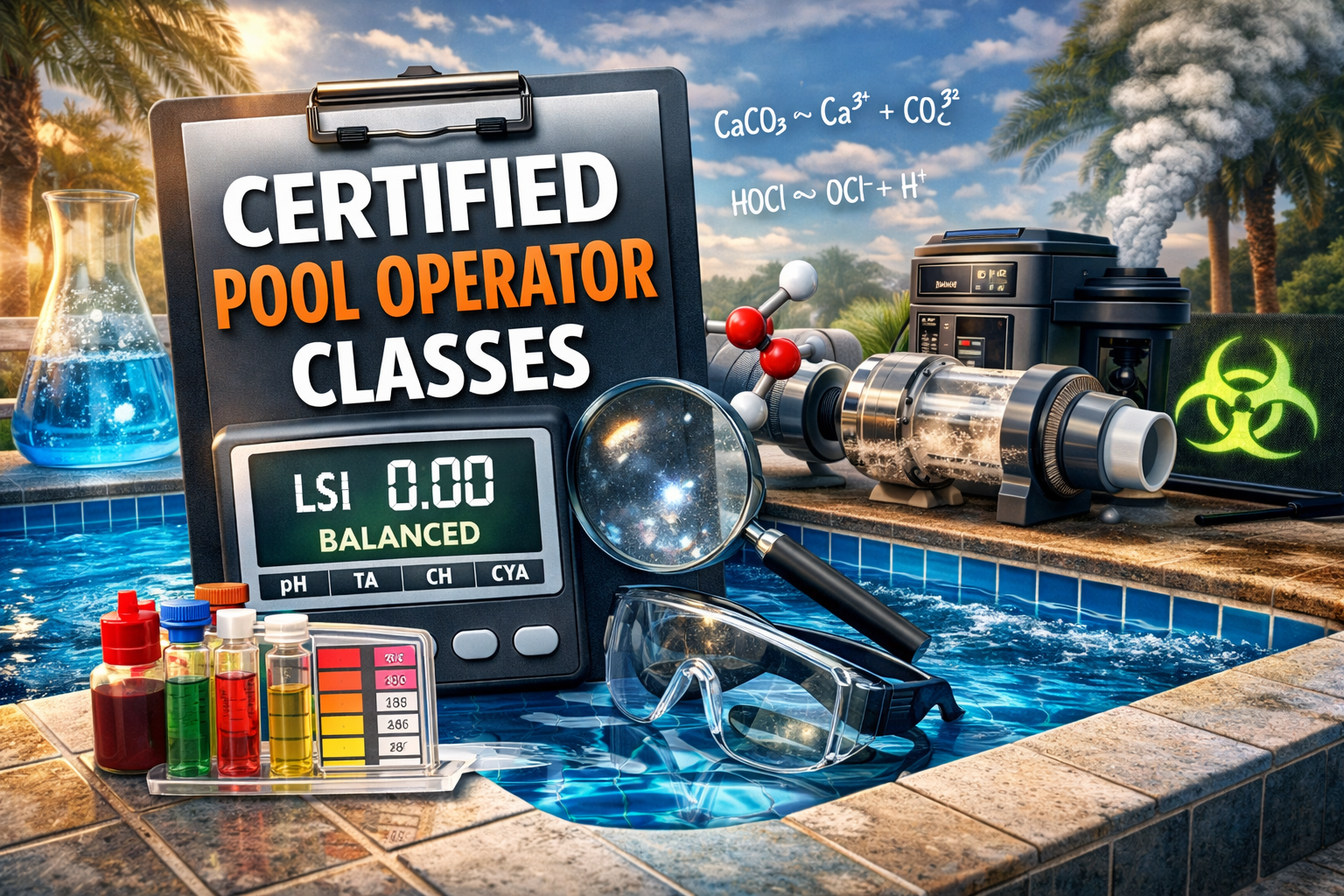

Certified Pool Operator Classes: Understanding LSI, Range Chemistry, and Real Water Balance
If you’ve ever taken one of my Certified Pool Operator classes, you already know this:
Water balance is not a number. It’s not 7.4. It’s not 0.00. It’s not “in range.”
It’s interaction.
And if you want to pass a CPO certification course and actually understand what you’re doing in the field — not just memorize boxes — then we need to talk about where range chemistry came from, what the Langelier Saturation Index (LSI) really does, and what it absolutely does not do.
Because if your entire professional identity is built around chasing 0.00 on a saturation calculator, we need to talk.
Not fight. Talk.
Listen to this episode here 👇
Where LSI Actually Came From (And Why That Matters in CPO Training)
Before backyard plaster pools.
Before inflatable flamingos.
Before margarita night.
There were municipal water systems.
In 1936, Wilford F. Langelier published his work in the Journal of the American Water Works Association. He wasn’t thinking about swimmers. He wasn’t thinking about eye irritation. He was trying to prevent municipal pipes from dissolving themselves from the inside out.
His question was brutally simple:
Is this water going to dissolve calcium carbonate, or deposit it?
From that came what we now call the Langelier Saturation Index (LSI).
LSI predicts whether water is:
- Undersaturated (corrosive, aggressive, “hungry”)
- Saturated (stable)
- Oversaturated (scale-forming)
That’s it.
It’s a calcium carbonate equilibrium model.
It was built to protect infrastructure — not manage sanitation.
Pools adopted it later because plaster is cement, and cement behaves like municipal concrete. Your pool is basically a miniature water distribution system… just with more sunscreen.
Understanding that origin story is critical in any serious Certified Pool Operator certification program. Because if you misunderstand LSI, you misunderstand balance.
What LSI Does — and What It Absolutely Does Not Do
In every high-quality CPO course, this distinction matters.
LSI DOES:
- Predict risk to plaster
- Predict scaling potential
- Predict etching potential
- Protect heater exchangers
- Protect salt cells
- Protect tile lines
LSI DOES NOT:
- Tell you if chlorine is killing pathogens fast enough
- Tell you if chloramines are forming
- Tell you if nitrification is occurring
- Tell you if biofilm is growing in plumbing
- Tell you if oxidation demand is overwhelming sanitizer
- Tell you if swimmers are comfortable
LSI protects the vessel.
It does not protect swimmers from microbiology.
Confusing LSI with total water quality is like confusing tire pressure with overall vehicle performance. Is tire pressure important? Absolutely. Is it the whole car? No.
And this is exactly the kind of nuance that separates someone who passes a Certified Pool Operator exam from someone who actually understands water chemistry.
The 7.2 – 7.8 pH Range: Not Divine Revelation
In CPO classes, we teach the 7.2–7.8 range. But where did that come from?
Nobody woke up one morning and declared it sacred.
It emerged from the overlap of three realities:
1. Human Physiology
- Human blood: ~7.35–7.45
- Tear fluid: near neutral
- Extreme deviation increases irritation risk
Public health authorities narrowed pH windows partly for comfort.
2. Chlorine Chemistry
Hypochlorous acid (HOCl) has a pKa around 7.5.
Lower pH → more HOCl → faster disinfection
Higher pH → more hypochlorite ion (OCl⁻) → slower kinetics
Mid-7s became a compromise between disinfectant strength and material safety.
3. Surface Protection
Under typical mid-20th-century pool chemistry, a pH around 7.4–7.6 often aligned with near-zero LSI when alkalinity and calcium were moderate.
So 7.2–7.8 became operationally practical.
Not holy.
Not mystical.
Convergent science.
That’s the kind of deeper explanation you should expect in a serious Certified Pool Operator class — not just “because the book says so.”
Total Alkalinity: The Most Misunderstood Number in Pools
In many CPO prep courses, alkalinity gets simplified to 80–100 ppm.
But alkalinity is not a single chemical species. It is acid-neutralizing capacity, mostly from the carbonate system.
It:
- Controls pH stability
- Influences carbon dioxide equilibrium
- Impacts acid demand
- Feeds directly into LSI
Here’s where technicians get into trouble:
If cyanuric acid (CYA) is present, total alkalinity includes cyanuric alkalinity.
If you do not subtract roughly one-third of the CYA level to estimate carbonate alkalinity, your LSI calculation is wrong.
Not slightly off.
Wrong in a way that makes you feel confident while being incorrect.
And that’s the most dangerous kind of wrong.
A quality Certified Pool Operator certification program should teach corrected alkalinity — not just how to punch numbers into an app.
Calcium Hardness: Why 200–400 ppm?
That range exists to reduce two risks:
- Low calcium + undersaturation → etching and leaching
- High calcium + oversaturation → scaling
But again — it’s a statistical sweet spot for average plaster pools under average conditions.
It assumes:
- Moderate temperature
- Moderate alkalinity
- Traditional plaster
- No extreme salt
- No unusual aeration
The moment you leave “average,” the boxes start sweating.
This is why elite operators don’t worship ranges. They understand systems.
The Blind Spot: LSI at 0.00 Does Not Mean “Safe”
You can have:
- LSI = 0.00
- CYA at 90 ppm
- pH at 7.8
- Rising combined chlorine
- Biofilm forming in plumbing
And your plaster is perfectly protected.
Is that pool balanced?
For calcium carbonate equilibrium? Yes.
For sanitation? Not necessarily.
LSI does not include:
- Cyanuric acid buffering effects
- Chlorine kinetics
- Nitrogen pathways
- Biofilm formation
- Disinfectant demand
This is not theoretical.
You can have a neutral LSI and rising combined chlorine at the same time.
That’s not exotic.
That’s Tuesday.
And understanding that distinction is essential to passing and applying knowledge from a Certified Pool Operator course.
Salt Systems and Micro-Environments
Most modern residential pools run 3,000–4,000 ppm sodium chloride.
Inside a salt cell:
- Electrolysis causes hydrogen evolution
- Local pH spikes dramatically
- Supersaturation conditions form
Your bulk water may show LSI 0.00.
Your salt cell may still scale.
LSI models bulk water.
It does not model micro-environments.
Same with heater exchangers:
- Temperature rises
- Solubility shifts
- Local precipitation occurs
If your Certified Pool Operator training didn’t explain this, you learned numbers — not chemistry.
Range Chemistry Is Not Stupid
Let’s be clear.
Range chemistry works surprisingly well under average conditions.
It is probabilistic chemistry.
It says:
If you keep everything inside these boxes, most of the time you won’t destroy the pool.
That’s not stupidity.
That’s operational practicality.
The mistake is believing the boxes are universal laws.
In a professional CPO certification class, you should learn both:
- The operational framework
- The underlying thermodynamics
Because mastery is not choosing one tool.
Mastery is knowing what each tool does — and does not do.
Who Invented 7.2–7.8?
No one.
There is no single documented origin.
It evolved from:
- Early 20th-century sanitation research
- Chlorine equilibrium characterization
- Cement durability studies
- Operator practicality
- Regulatory codification
- Even the readability range of phenol red
Phenol red transitions clearly between roughly 6.8 and 8.2.
The most readable band? 7.0–8.0.
What operators can see clearly, they standardize.
Over time, that overlap became doctrine.
Not invention.
Convergence.
What You Should Expect from a Certified Pool Operator Class
If you’re looking for a Certified Pool Operator certification, here’s what matters:
You shouldn’t just memorize:
- 7.2–7.8
- 80–100
- 200–400
- LSI = 0.00
You should understand:
- How LSI protects surfaces
- How chlorine kinetics change with pH
- How CYA alters disinfectant performance
- How nitrogen chemistry drives chloramine formation
- How biofilm survives inside plumbing
- How salt systems create micro-scaling environments
- How temperature shifts equilibrium
Because balance is not a number.
Balance is the interaction of:
- Thermodynamics
- Kinetics
- Microbiology
- Material science
And when you understand that, you stop chasing perfect numbers.
You start managing systems.
Ready to Take Your Certified Pool Operator Training Further?
If you’re serious about advancing in this industry — whether you’re:
- A pool service professional
- A facility operator
- A maintenance technician
- A health department professional
- Or someone preparing for the CPO exam
You need more than flashcards.
You need context.
That’s exactly what we teach in our Certified Pool Operator classes — not just how to pass the exam, but how to understand the water in front of you.
Because the difference between someone who maintains numbers and someone who understands systems?
That’s education.
And that’s what professional CPO training is supposed to deliver.
For the dates and times of our next Certified Pool Operator certification course, visit us at CPO Class Schedule and Registration