
Development of a Field Protocol and Independent Replication: Reduction of Cyanuric Acid in Swimming Pool Water Using Aluminum Sulfate
Rudy Stankowitz
Aquatic Facility Training & Consultants, Archer, Florida, USA
Corresponding author: Rudy Stankowitz | Contact information to be inserted before submission
Manuscript type: Field methods report and retrospective evidence synthesis
Original Manuscript: Lower Cyanuric Acid in Swimming Pools Chemically
Abstract
Background: Elevated cyanuric acid (CYA) can slow chlorine disinfection kinetics in stabilized swimming pools. Dilution is effective but may be undesirable where water is scarce or discharge is constrained. Beginning in 2019, a field protocol was developed to reduce CYA using aluminum sulfate (alum), followed by sedimentation and vacuuming to waste.
Effective methods for the Reduction of Cyanuric Acid are crucial for maintaining pool water quality and ensuring proper chlorine disinfection.
Objective: To document the development, operating conditions, publicly reported field observations, and independent evaluation of the alum–CYA reduction protocol, while distinguishing observed CYA reduction from the proposed aluminum–cyanurate mechanism.
The goal of the Reduction of Cyanuric Acid is to provide a reliable protocol for pool operators.
Methods: Publicly available reports issued from 2019 through 2025 were reviewed, including the originator’s contemporaneous method reports, independently authored trade publications, publicly posted field observations, and a two-page technical report from the onBalance research group. Reports containing numerical pre- and post-treatment CYA values were extracted descriptively. Because individual-level source records, standardized sampling plans, and complete denominators were unavailable, no inferential statistical analysis or pooled efficacy estimate was performed.
Results: The standardized protocol used 8.33 lb aluminum sulfate per 10,000 U.S. gal (approximately 100 mg/L product), pH approximately 7.0, total alkalinity 80–120 mg/L as CaCO₃, calcium hardness 200–400 mg/L as CaCO₃, and water temperature 70–90 °F (21–32 °C). Water was circulated for 2 h with filtration media bypassed, allowed to settle for at least 12 h, and vacuumed slowly to waste. Public field reports with interpretable paired values generally described CYA reductions of approximately 18–50%, although one under-dosed trial produced only a 7.8% reduction and one extreme report was not considered reliable for efficacy estimation. Independently, onBalance reported approximately 15–20% reduction in laboratory evaluation and 25% reduction in a residential pool, the latter including sediment and water removal during vacuuming to waste.
Understanding the Reduction of Cyanuric Acid can lead to better pool maintenance practices.
Conclusions: Available evidence supports the conclusion that the complete alum flocculation, settling, and vacuum-to-waste procedure can produce measurable reductions in apparent CYA concentration under specified field conditions. The magnitude of reduction is variable. Existing evidence does not establish the molecular identity or stoichiometry of the removed material, nor does it fully separate complexation, adsorption or enmeshment by aluminum hydroxide floc, analytical interference, and limited water-replacement effects. A prospective controlled study using validated analytical methods and mass-balance measurements is required.
The findings indicate that the Reduction of Cyanuric Acid is a viable solution for pool water management.
Keywords: cyanuric acid; aluminum sulfate; alum; swimming pools; coagulation; flocculation; water conservation; cyanurate
Introduction: Reduction of Cyanuric Acid in Swimming Pool Water Using Aluminum Sulfate
Cyanuric acid is used in outdoor swimming pools to reduce photolytic loss of free chlorine. Its benefit is accompanied by slower algicidal and antimicrobial activity as CYA concentration increases, and accumulated CYA has traditionally been managed by partial draining and replacement with lower-CYA water [1–3]. In drought-prone regions, or where discharge is limited, dilution can impose substantial water and operational costs.
The Reduction of Cyanuric Acid helps in optimizing chlorine efficiency.
In 2019, Stankowitz began field experiments using aluminum sulfate as a means of lowering CYA in swimming-pool water. The concept arose from the known use of alum as a coagulant and the recognized ability of cyanurate to form poorly soluble salts with certain metal ions. Preliminary success was publicly announced during “The Great Cyanuric Acid Debate” at the International Pool Spa Patio Expo in New Orleans on 6 November 2019 and described online on 17 November 2019 [4,5]. The early report explicitly characterized the method as experimental and requested independent field observations.
Techniques for the Reduction of Cyanuric Acid are being explored to improve the overall efficacy of pool treatments.
A standardized procedure was published in November 2020 with John Poma, who had conducted a substantial share of the early field applications [6]. Subsequent independent trade coverage described successful field use [7], while a contemporaneous critique proposed that residual alum might interfere with the turbidimetric CYA test and create an apparent rather than actual reduction [8]. In 2023–2024, the onBalance research group evaluated the method in laboratory and residential-pool settings and reported reproducible, although more modest, reductions [1,9].
As the Reduction of Cyanuric Acid protocol gains traction, more studies will emerge concerning its effectiveness.
This paper consolidates the available evidence without treating trade publication, public comments, or retrospective reports as equivalent to controlled peer-reviewed experimentation. Its objectives are to document the protocol and chronology, summarize the quantitative observations that can be recovered, identify plausible explanations for the observed decrease, and define a rigorous prospective validation study.
This paper highlights the importance of the Reduction of Cyanuric Acid as part of modern pool management.
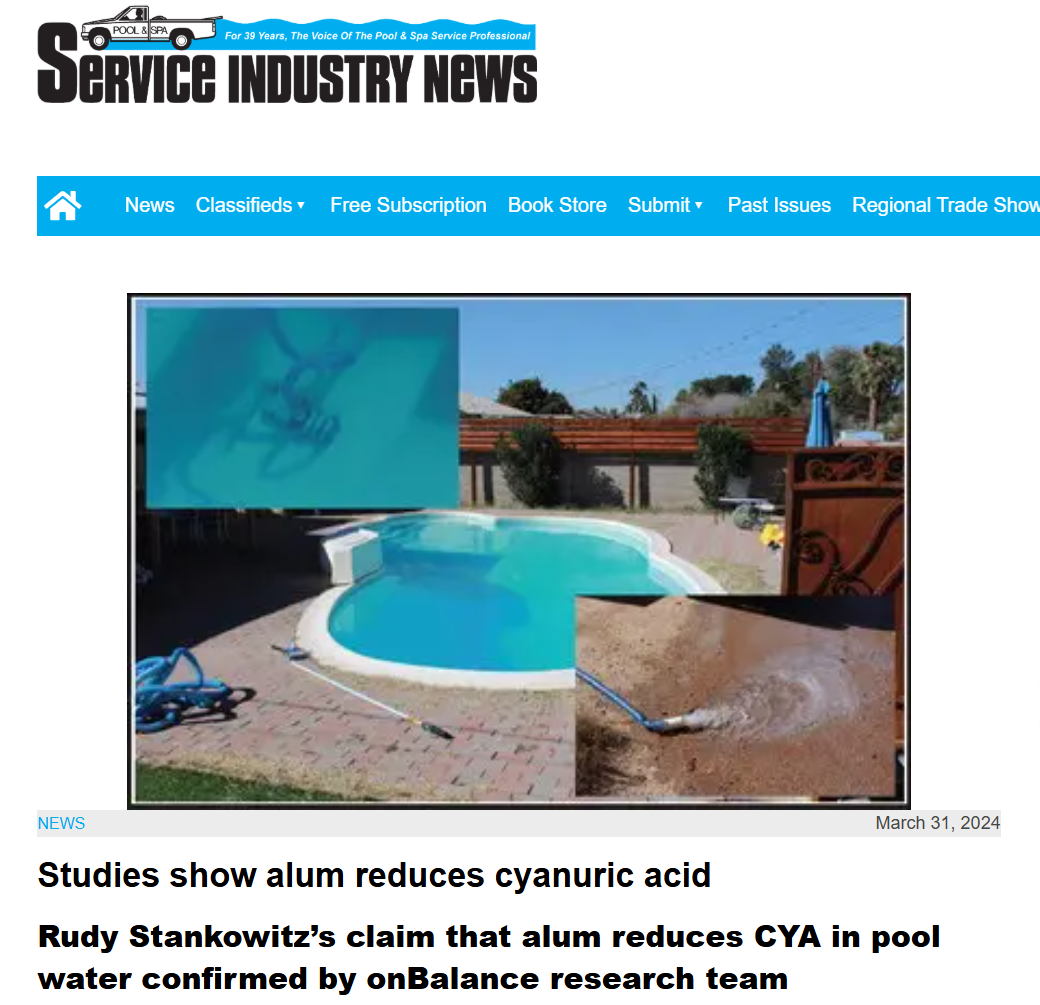
Similar Article: Studies show alum reduces cyanuric acid
Materials and Methods
Evaluating the Reduction of Cyanuric Acid in various settings will enhance understanding of its applications.
Study design and evidence sources
This report is a retrospective field-methods paper and structured evidence synthesis. Sources were eligible when they described the alum–CYA method, reported its chronology or operating conditions, supplied numerical pre- and post-treatment CYA measurements, independently evaluated the procedure, or directly addressed the chemical plausibility or measurement limitations. Sources reviewed included CPOClass method reports and public field comments, AQUA Magazine articles, Service Industry News reporting, the onBalance technical report, and Seifer’s review of cyanuric acid and cyanurates [1,4–11].
The search was not a systematic review of all CYA-removal technologies. Duplicate reproductions were consolidated. Claims were classified as originator observations, independent field observations, independent laboratory or field replication, mechanistic literature, or critique. Later summaries were not used to move a detail backward in time unless an earlier dated source supported it.
Future research in the Reduction of Cyanuric Acid will address lingering questions and refine protocols.
Standardized treatment protocol
| Step | Operating condition |
| 1 | Adjust pH to approximately 7.0. |
| 2 | Adjust total alkalinity to 80–120 mg/L as CaCO₃ and calcium hardness to 200–400 mg/L as CaCO₃; water temperature 70–90 °F (21–32 °C). |
| 3 | Remove heavy debris and obtain a pretreatment CYA measurement. |
| 4 | Bypass sand or diatomaceous-earth filter media using recirculate, or remove the cartridge element. |
| 5 | Broadcast aluminum sulfate at 8.33 lb per 10,000 U.S. gal (3.78 kg per 37.85 m³; approximately 100 mg/L product). |
| 6 | Circulate for 2 h, then stop circulation. |
| 7 | Allow quiescent settling for at least 12 h. |
| 8 | Vacuum settled floc slowly to waste with a portable vacuum system. |
| 9 | Measure post-treatment CYA and residual aluminum; the field protocol specifies residual aluminum below 0.2 mg/L. |
The original protocol warned against application by untrained homeowners and did not recommend the process for saltwater pools or pigmented plaster pending further testing [4,6]. Sulfate accumulation, surface compatibility, safe discharge, and local codes require site-specific professional evaluation.
Data extraction and analysis
The data derived from the Reduction of Cyanuric Acid studies underscores its potential benefits.
For public reports containing paired values, percentage reduction was calculated as 100 × (initial CYA − final CYA) / initial CYA. Reports stating only “greater than 100 mg/L” were retained as qualitative observations but excluded from percentage calculations. Extreme values outside ordinary direct-test ranges, results lacking a defined test method, and reports that materially deviated from the protocol were flagged. No pooled mean, confidence interval, hypothesis test, or claim of statistical significance was calculated because the cases were self-selected, the denominator of unsuccessful attempts was unknown, measurement methods varied, and raw records were unavailable.
Results
Development and external replication
The first dated public method report described an alum dose of approximately 100 mg/L, a target pH of 7.0, water temperature above 70 °F, bypass circulation followed by approximately 12 h of settling, and slow vacuuming to waste. The originator reported an approximately 50% decrease from an initial range of 90–100 mg/L but stated that the work was preliminary and not yet proven [4]. The more detailed November 2020 protocol formalized the water-balance and equipment requirements and credited Poma’s extensive field participation [6].
In its technical report, onBalance identified the procedure as developed and promoted by Stankowitz and reproduced the protocol substantially as published. The group reported approximately 15–20% CYA reduction in laboratory evaluation and 25% in a residential pool. The residential procedure included removal of floc and water by vacuuming to waste. OnBalance listed speed and simplicity as strengths and chemistry, temperature, vacuuming expertise, some water loss, and limited removal relative to other tested methods as weaknesses [1]. Service Industry News independently reported the same results and quoted Que Hales as obtaining consistent 25% reductions using the method [9].
Similar Article: Cyanuric Acid Removal – Alum Floc
Recoverable public field observations
| Reporter | Initial | Final | Reduction | Protocol notes | Interpretation |
| Originator, 2019 | 90–100 | ≈45–50 | ≈50% | Target dose; pH 7.0; >70 °F | Preliminary range; exact paired record unavailable |
| Under-dosed field report | 141 | 130
Understanding the mechanisms behind the Reduction of Cyanuric Acid can lead to improved treatment strategies. |
7.8% | 5.5 lb in 11,887 gal; ≈56% target dose | Material protocol deviation |
| Field report
The practical applications of the Reduction of Cyanuric Acid in the field are becoming increasingly evident. |
160 | 95 | 40.6% | 13.22 lb in 11,887 gal; ≈134% target dose | Over target dose; mixed test methods |
| Jewell | 630 | 315 | 50.0% | Diluted visual test; 48-h settling; pH fell to 6.2–6.4 | Very high CYA; dilution magnifies uncertainty |
| Ward | 80 | 55 | 31.3% | 8 lb/10,000 gal; vacuumed to waste | Taylor K-2006; post-sample before refill |
| Field report A | 700 | 100 | 85.7% | 8 lb/10,000 gal | Extreme outlier; test method/range unclear |
| Field report B | 100 | 80 | 20.0% | 8 lb/10,000 gal; no refill | Approximate pH 6.6 after treatment |
| Field report C | 140 | 90 | 35.7% | 8 lb/10,000 gal; no refill | Approximate pH 6.6 after treatment |
| Weaver trial 1 | 165 | 130 | 21.2% | SpinLab | Independently authored trade report
Independent evaluations of the Reduction of Cyanuric Acid are crucial for validating its effectiveness. |
| Weaver trial 2 | 140 | 115 | 17.9% | SpinLab | Independently authored trade report |
| onBalance laboratory | Not reported | Not reported | 15–20% | Laboratory evaluation | Independent aggregate result |
| onBalance residential | Not reported | Not reported | 25% | Floc and water vacuumed to waste | Independent aggregate result |
The table demonstrates both a signal and substantial heterogeneity. Reports near the standardized dose commonly fell within an approximately 18–50% range, but data quality was inconsistent. The under-dosed case produced a smaller change. The 700-to-100 mg/L report is biologically and operationally possible only with extraordinary removal but is analytically difficult to interpret because common CYA methods require dilution at such concentrations; it was therefore treated as an outlier rather than evidence of expected efficacy. Cases with only “>100 mg/L” starting values could not yield valid percentage reductions.
Mechanistic evidence
Aluminum sulfate hydrolyzes in water and generates aluminum hydroxide floc while consuming alkalinity and lowering pH. The floc can adsorb or enmesh suspended and colloidal material. At pool pH, CYA is predominantly present as a dissolved monoanionic cyanurate species [8]. Seifer reviewed aluminum–cyanurate systems and reported several white, poorly soluble compounds in the AlCl₃–Na₃C₃N₃O₃–H₂O system. The composition depended on reagent ratio and solution conditions; a nominal trisubstituted aluminum cyanurate was reported to precipitate only over a narrow range in the investigated system [10]. These findings establish chemical plausibility for aluminum–cyanurate precipitation, but they do not demonstrate that the same solid forms when aluminum sulfate is added to chemically complex swimming-pool water near pH 7.
Accordingly, the current evidence supports several nonexclusive explanations: direct formation of poorly soluble aluminum–cyanurate species; adsorption or coprecipitation of cyanurate with aluminum hydroxide; physical entrapment within settling floc; removal of a CYA-associated phase; and analytical effects on turbidimetric testing. The recovered studies did not chemically characterize the settled material. The molecular mechanism and product stoichiometry therefore remain unresolved.
Discussion: Reduction of Cyanuric Acid in Swimming Pool Water Using Aluminum Sulfate
Discussions surrounding the Reduction of Cyanuric Acid have sparked interest in alternative pool maintenance methods.
The central reproducible finding is narrower, but stronger, than some early industry claims: a complete high-dose alum flocculation procedure followed by sediment removal can reduce measured CYA in swimming-pool water. Independent onBalance testing supports an approximate 15–20% laboratory effect and a 25% residential-pool effect. Public field reports show that larger decreases sometimes occur, but they cannot define expected efficacy because the cases were uncontrolled, selectively reported, and measured with different methods.
The laboratory result is particularly important because it demonstrates a reduction without relying solely on dilution from refill water. Conversely, the residential result cannot be attributed entirely to a chemical reaction because vacuum-to-waste is integral to removal and causes some water loss. Water removal alone should not change the CYA concentration in the water remaining before refill if CYA is uniformly dissolved; after refill, dilution contributes in proportion to the replaced volume. Future work should measure pool volume before and after vacuuming and sample both before and after refill.
Analytical uncertainty
Most pool CYA measurements are based on melamine–cyanurate turbidity. Lowry proposed that residual alum could alter particle formation or settling in the test sample and produce an artificially low value [8]. The current public record does not fully resolve that objection. OnBalance described its measurements as turbidity testing, and the field reports used visual turbidity, photometric spin-disk instruments, or both. A validation study should compare the routine pool method with an alum-independent reference method, use matrix spikes and recovery experiments, and document the time between treatment and analysis.
Operational interpretation
The procedure should not be described as eliminating the need for dilution in every pool. It requires a comparatively large alum dose, exact water preparation, temporary filter bypass, quiescent settling, specialized vacuum-to-waste technique, subsequent rebalancing, and controlled disposal. It also introduces sulfate and can sharply reduce pH and alkalinity. The method is most plausibly useful when partial CYA reduction and water conservation are more important than maximum removal, and when a qualified pool professional can control the process.
A treatment target should be based on the required operating CYA range rather than maximum possible removal. Repeated treatments would add sulfate and increase operational risk. Saltwater pools, pigmented surfaces, pools containing elevated metals, and sites with discharge restrictions require additional evaluation. The procedure is not a substitute for professional, site-specific judgment.
Limitations
Future studies will play a pivotal role in understanding the challenges associated with the Reduction of Cyanuric Acid.
This paper relies substantially on retrospective reports and trade literature. Complete pool-level records, unsuccessful-case denominators, prespecified sampling times, calibration records, product hydration state and purity, pool-volume verification, vacuumed water volumes, and chain-of-custody laboratory results were unavailable. Environmental and chemical covariates were inconsistently recorded. Public comments are vulnerable to selection and reporting bias. Some very high CYA measurements required dilution and have large propagated uncertainty. The independent technical report provides aggregate percentage ranges without replicate counts, raw values, uncertainty estimates, or detailed controls. No recovered study chemically identified the settled solid. These limitations preclude a pooled efficacy estimate, causal attribution to a specific molecular pathway, or a claim of statistical significance.
Proposed prospective validation
| Element | Recommended design |
| Design | Randomized controlled bench study followed by a preregistered paired field study. |
| Controls | Untreated control; vacuum-and-refill control matched for water loss; alum treatment without vacuum; complete protocol. |
| Dose response | 0, 25, 50, 75, and 100 mg/L aluminum sulfate product; record exact chemical form and assay. |
| Water matrix | Factorial pH, alkalinity, temperature, calcium, copper, phosphate, and initial-CYA conditions. |
| Measurement | Routine melamine turbidity plus an independent validated reference method; blinded duplicates, spikes, and recovery checks. |
| Mass balance | Measure water volume, CYA in water, CYA in removed supernatant/sludge, aluminum, sulfate, and solids. |
| Solid analysis | Elemental analysis and suitable spectroscopic/diffraction methods to distinguish cyanurate complexes from adsorption to Al(OH)₃. |
| Reporting | All trials, failures, exclusions, raw values, uncertainty, adverse surface/equipment effects, and post-treatment rebound monitoring. |
Conclusions: Reduction of Cyanuric Acid in Swimming Pool Water Using Aluminum Sulfate
Ultimately, the Reduction of Cyanuric Acid represents a significant advancement in pool chemical management.
The available record supports a practical finding: under defined chemistry and temperature conditions, 8.33 lb aluminum sulfate per 10,000 gal followed by approximately 2 h of circulation, at least 12 h of settling, and slow vacuuming to waste can measurably lower CYA readings. Independent onBalance testing reported approximately 15–20% reduction in the laboratory and 25% in a residential pool. Public field observations indicate that reductions of approximately 20–50% may occur, but those reports are insufficient to establish a general efficacy distribution.
The evidence does not yet establish that a specific aluminum cyanurate compound is the principal removal product. The defensible conclusion is therefore procedural rather than molecular: the complete alum-floc and solids-removal process reduces measured CYA under some pool conditions. Controlled testing with independent analytical confirmation and mass balance is required before the mechanism, dose response, repeatability, and safety envelope can be stated with confidence.
Supporting Research: Cyanuric Acid and Cyanurates
Declarations
Funding: No external funding was reported for preparation of this manuscript. Insert any material support for the original field work before submission.
Competing interests: Rudy Stankowitz is President and CEO of Aquatic Facility Training & Consultants and provides education and consulting services to the swimming-pool industry. Insert any relevant alum-product sales, sponsorships, consulting relationships, or other financial interests before submission.
Ethics statement: The report concerns water-treatment observations and contains no human or animal subjects research.
Data availability: The numerical observations summarized here are available in the cited public sources. The underlying individual field records and the raw onBalance laboratory data were not available for this draft. This statement must be revised if source datasets are obtained.
Author contributions: Rudy Stankowitz conceived and developed the field method and authored the underlying reports. Formal contribution statements for any added coauthors must be agreed before submission.
Acknowledgments: John Poma is acknowledged for extensive early field applications and refinement of the step-by-step procedure. Que Hales, Doug Latta, and Kim Skinner of onBalance are acknowledged for independent laboratory and residential-pool evaluation. Marcelle Dibrell is acknowledged for contemporaneous reporting and for identifying relevant cyanurate literature. Acknowledgment does not imply endorsement of this manuscript; written permission should be obtained where required by the target journal.

References
- 1. Hales Q, Latta D, Skinner K. Cyanuric Acid Removal—Alum Floc. onBalance; 2024. https://www.poolhelp.com/wp-content/uploads/2024/06/Removing-Cyanuric-Acid-Alum.pdf
- 2. Wojtowicz JA. The effect of cyanuric acid on swimming pool water chemistry. Journal of the Swimming Pool and Spa Industry. 2004;5(1):15–19. [Bibliographic details to verify against the original before submission.]
- 3. Centers for Disease Control and Prevention. Model Aquatic Health Code. Current edition. [Insert the specific edition and relevant section required by the target journal.]
- 4. Stankowitz R. Lower Cyanuric Acid in Swimming Pools Chemically. CPOClass. Published November 17, 2019; updated March 31, 2024. https://cpoclass.com/lower-cyanuric-acid-levels/
- 5. Service Industry News. How to remove cyanuric acid from pool water. Published January 31, 2021. https://www.serviceindustrynews.net/2021/01/31/how-to-remove-cyanuric-acid-from-pool-water/
- 6. Stankowitz R, Poma J. Alum CyA Removal Method Step-By-Step. CPOClass. Published November 24, 2020. https://cpoclass.com/cya-removal-method/
- 7. Weaver D. A New Way to Remove CYA? AQUA Magazine. Published March 4, 2021. https://www.aquamagazine.com/service/article/15123094/a-new-way-to-remove-cya
- 8. Lowry RW. Notes From Bob Lowry: The CYA Debate Continues. AQUA Magazine. Published 2020. https://www.aquamagazine.com/retail/article/15123032/notes-from-bob-lowry-the-cya-debate-continues
- 9. Dibrell M. Studies show alum reduces cyanuric acid. Service Industry News. Published March 31, 2024. https://www.serviceindustrynews.net/2024/03/31/studies-show-alum-reduces-cyanuric-acid/
- 10. Seifer GB. Cyanuric acid and cyanurates. Russian Journal of Coordination Chemistry. 2002;28:301–324. doi:10.1023/A:1015531315785.
- 11. Stankowitz R. Research Update: CYA Removal Method Confirmed. AQUA Magazine. Published June 20, 2023. https://www.aquamagazine.com/service/article/15447703/research-update-cya-removal-method-confirmed
- 12. Stankowitz R. Alum-CyA “Tech Bulletin” Response. CPOClass. Published November 16, 2020. https://cpoclass.com/alum-cya-tech-bulletin/
- 13. Stankowitz R. Removal of Cyanuric Acid by Aluminum Cyanurate Complexation. ResearchGate. Published September 2024. doi:10.13140/RG.2.2.29738.84168.