

This Technical Bulletin Black Algae is intended for professional pool service technicians. It assumes a working
knowledge of pool water chemistry, algae identification, and treatment practices.
Introduction
For decades, black algae has been one of the toughest challenges in swimming pool care. It
was long assumed to be a type of algae resistant to chlorine. My research beginning in 2018
proved otherwise: black algae is not algae at all, but a cyanobacteria biofilm. These colonies
protect themselves with a thick exopolysaccharide (EPS) coating that blocks sanitizer
penetration and infiltrates surface pores in plaster and grout. What some in the field have
described as ‘roots’ are, in reality, EPS projections — sticky polysaccharide material that
locks colonies into rough surfaces.
Initial Findings (2018)
Dime-sized field specimens of black algae collected from “Gainesville A” public swimming
pool were identified as thick matted layers comprised of not one, but several genus of
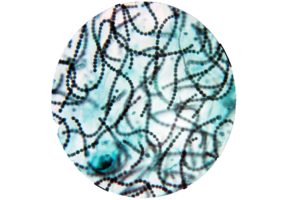
cyanobacteria (blue/green algae) in an intertwined colony. Oscillatoria sp., Microcoleous,
and Nostoc sp. were the most prevalent. Samples collected from a second recreational water
venue (Atlantic Beach) did not contain Nostoc sp., Microcoleus and Oscillatoria as we had
identified in our Gainesville A colonies. Our new specimens contained the filamentous
cyanobacteria Leptolyngbya sp. This is a noteworthy discovery evidencing that the
constituents of swimming pool “black algae” can differ greatly with variables such as
distance, and in as little as 100 miles. We have also positively identified several species of
true algae in this sample that have taken harbor in the cyanobacteria’s exopolysaccharidic
secretions. This allows us to refer to “black algae” as a Collective Cyanobacteria Community;
a biofilm with cyanobacteria as the dominant constituent.
One can theorize the eukaryotic inhabitants of the biomass to vary by geographic location as
we found of the photosynthetic prokaryotes. Samples from a third recreational water venue
were collected (Gainesville B) within one mile of the initial location (Gainesville A). As we
had seen in our “Atlantic Beach” specimens, Leptolyngbya sp. dominated the biomass. Also
found in our “Gainesville B” sample were the cyanobacteria Oscillatoria sp. and
Synechococcus sp.. The chlorine level in this sample was neutralized with ascorbic acid. The
Assay value in our test results show that a positive test was achieved indicating that a trace
level of microcystin was detected in our specimens upon lysis. However, at 0.08 ng/mL; the
level detected by the ELISA in our samples is much lower than the benchmark of 0.15 ppb
and much lower than the EPA Drinking Water Health Advisory (HA) maximum
recommended level of 1.6 micrograms per liter.
Wet mounts were prepared and scanned at 100X for the presence of potentially toxigenic
(PTOX) cyanobacteria using a Nikon Eclipse Ti-S Inverted Microscope equipped with phase
contrast optics and epifluorescence. Higher magnification was used as necessary for
identification and micrographs. Enzyme-linked Immunosorbent Assay
Download complete Technical Bulleting Here 👇