
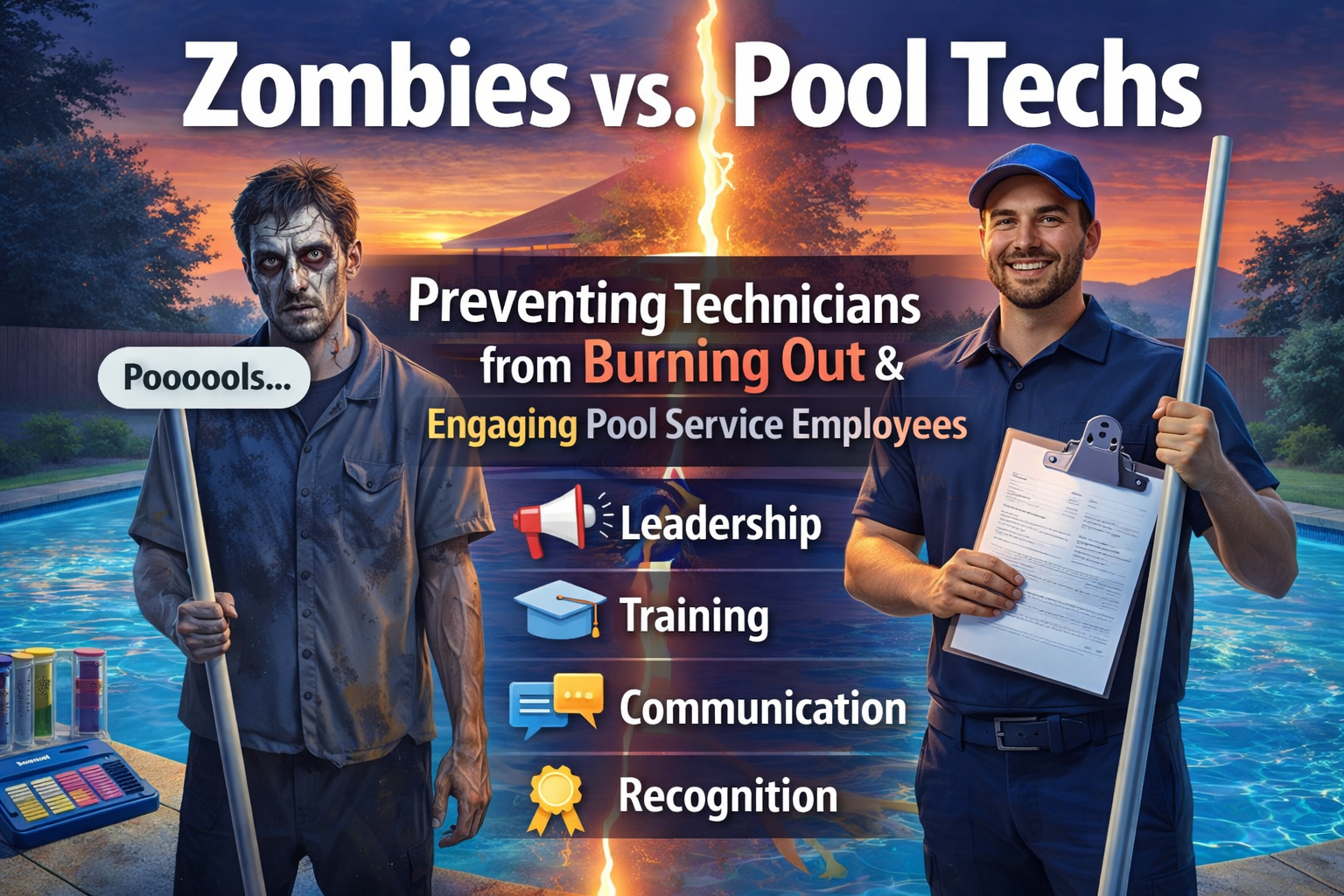

How Pool Service Companies Keep Employees Engaged and Prevent Burnout
The evaporation fog hangs low over the swimming pool like a horror movie set.
Morning light slowly pushes back the night. Orange streaks cut across the clouds as the sun climbs above the rooftops.
The gate to the backyard lets out a slow metallic groan.
A pool technician steps through.
Shoulders slumped. Telepole dragging. Eyes fixed on the water like someone who has stared at too many pools for too many years.
He reaches the edge of the deck and pauses.
“Poooools…” he mutters quietly.
Congratulations.
Your company has just encountered The Walking Tech.
The Walking Tech: When Pool Technicians Stop Caring
Most pool companies eventually experience it.
The technician still shows up.
The route still gets serviced.
But something is missing.
The curiosity.
The pride.
The attention to detail.
Instead of a professional maintaining an aquatic system, you now have someone simply moving from pool to pool trying to finish the day.
Employee disengagement is not unique to the pool industry. It is a well-documented organizational problem across many service professions.
Research conducted by Gallup’s State of the Global Workplace has consistently shown that disengaged employees reduce productivity, increase turnover, and weaken customer satisfaction across industries.
For pool service companies, disengagement can quietly cost thousands of dollars in missed opportunities and preventable problems.
Because the backyard is not just where the work happens.
It is also where the opportunities are discovered.
The Backyard Is Your Sales Floor
Every pool technician is the company’s eyes and ears.
They see the heater with scale building inside the exchanger.
They hear the pump bearings starting to fail.
They notice when chlorine demand begins climbing or when filtration is starting to struggle.
An engaged technician recognizes these signals and communicates them.
A disengaged technician finishes the route and drives away.
That difference can determine whether a company prevents problems early or responds to emergencies later.
Field service industries rely heavily on the observational skill and initiative of technicians. When engagement drops, those observations disappear.
Why Pool Technicians Burn Out
Burnout is one of the most widely studied phenomena in occupational psychology.
Researchers Christina Maslach and Michael Leiter describe burnout as a syndrome involving emotional exhaustion, depersonalization, and reduced professional accomplishment (Annual Review of Psychology).
Pool service work contains several risk factors known to contribute to burnout:
-
long hours working alone
-
repetitive daily task cycles
-
limited social interaction
-
high physical workload
-
customer expectations that appear only when something goes wrong
A technician may spend eight hours traveling between backyards without interacting with coworkers.
When everything works properly, no one notices.
When something fails, suddenly everyone is paying attention.
Over time, this dynamic can slowly erode engagement.
The Isolation Problem in Pool Service
Isolation is one of the most overlooked contributors to burnout in field service work.
Technicians often spend entire workdays without meaningful conversation with coworkers. While some independence is appealing, prolonged isolation can weaken an employee’s sense of connection to the company.
Occupational research has shown that employees who feel disconnected from their organization are significantly more likely to disengage from their work.
For service companies, maintaining connection requires deliberate effort through communication, training, and regular interaction.
Otherwise, technicians begin to feel less like professionals and more like anonymous labor.
The Seven Warning Signs a Pool Technician Is About to Quit
Technicians rarely resign suddenly.
Most employees begin disengaging long before the resignation notice appears.
Recognizing the warning signs early allows companies to intervene before valuable employees leave.
Curiosity Disappears
Engaged technicians ask questions.
Why did the chlorine demand increase?
Why is the heater short-cycling?
Why is the filter pressure creeping up?
When engagement declines, curiosity fades.
Pools get serviced, but the deeper interest in understanding problems disappears.
Curiosity is strongly linked to professional engagement and learning behavior.
When curiosity fades, disengagement has often already begun.
Communication Gets Shorter
Technicians who once shared observations about equipment problems or water chemistry issues begin communicating less.
The route gets completed.
But the conversations disappear.
Communication decline is a common early signal of disengagement.
Pride in Work Fades
Skilled technicians take pride in their work.
They notice crooked equipment lids.
They wipe down messy pads.
They take satisfaction in leaving water crystal clear.
When engagement fades, the extra attention disappears.
The work becomes routine.
Preventative Thinking Stops
Experienced technicians constantly anticipate problems.
They hear a pump bearing starting to fail before it becomes obvious.
They recognize early signs of scaling or corrosion.
Disengaged technicians stop thinking ahead.
They respond only when problems become unavoidable.
Preventative thinking requires mental investment.
Without engagement, it disappears.
Energy Levels Change
Burnout often appears through emotional exhaustion and fatigue.
Workers may move slower, appear withdrawn, or become frustrated with routine tasks.
These behaviors are sometimes misinterpreted as laziness, when they may actually be symptoms of burnout.
Initiative Declines
Engaged technicians offer ideas.
They recommend equipment improvements.
They help new technicians solve problems.
When initiative disappears, the technician is often mentally withdrawing from the organization.
The Technician Mentally Leaves Before Physically Leaving
Research on employee turnover consistently shows that workers often disengage psychologically before they resign.
By the time a technician submits notice, the decision has usually been forming for months.
How Smart Pool Companies Prevent Technician Burnout
Forward-thinking service companies address engagement before burnout spreads.
They focus on four key factors:
-
leadership behavior
-
education and training
-
communication
-
recognition
These strategies consistently appear in research on employee retention and organizational performance.
Leadership Sets the Tone
Employee engagement often mirrors leadership engagement.
Studies from leadership training programs such as Dale Carnegie Training have found that employees are significantly more engaged when they believe their managers lead by example.
Technicians notice when leadership demonstrates curiosity, professionalism, and pride in the work.
They also notice when leadership appears disconnected.
Engagement starts at the top.
Education Turns a Job Into a Profession
Training is one of the most powerful tools for improving employee engagement.
Research in workforce development has repeatedly shown that employees who receive professional education demonstrate higher commitment and retention.
In the pool industry, technicians often receive minimal training beyond basic procedures.
When employees understand the science behind their work, something changes.
Testing chlorine becomes water sanitation.
Balancing chemistry becomes environmental management.
Servicing equipment becomes preventative engineering.
The work gains meaning.
Recognition Reinforces Engagement
Recognition is one of the simplest and most effective motivation tools available to employers.
Studies in organizational psychology consistently show that employees who receive recognition demonstrate higher motivation and job satisfaction.
For pool technicians, much of the work happens quietly in backyards where few people see it.
A simple acknowledgment of good work can reinforce pride and professionalism.
Recognition does not have to be complicated.
Sometimes a simple “Nice job spotting that heater issue before it failed” goes further than a quarterly performance review.
Equip Your Technicians Properly
No employee remains motivated while fighting broken equipment every day.
Professional technicians need professional tools.
Reliable test kits
functional vacuums
proper safety equipment
well-maintained service vehicles
Providing proper tools signals that the company values the work being performed.
Training as a Retention Strategy
One of the most effective ways pool companies strengthen technician engagement is through professional training.
Programs such as Certified Pool Operator (CPO®) certification introduce technicians to the chemistry, microbiology, and engineering principles that govern aquatic environments.
Technicians learn:
-
water sanitation science
-
chlorine chemistry
-
filtration and hydraulics
-
equipment operation
-
public health protection
When employees understand the scientific importance of their work, routine tasks gain meaning.
Servicing a pool becomes more than maintenance.
It becomes protecting public health.
Find a Certified Pool Operator Class HERE: https://cpoclass.com/cpo-pool-operator-certification/
The Difference Between a Pool Tech and an Aquatic Professional
A disengaged technician cleans pools.
An engaged technician manages water treatment systems.
They notice problems early.
They protect equipment.
They prevent unsafe swimming conditions.
They take pride in their work.
That difference is not simply experience.
It is engagement.
And engagement grows through leadership, education, communication, and recognition.
Professional Training for Pool Technicians
Many pool service companies strengthen technician engagement through formal education programs.
Certified Pool Operator (CPO®) certification training provides pool professionals with the scientific and operational knowledge needed to manage aquatic facilities safely.
Training covers:
-
water chemistry and sanitation
-
filtration and circulation systems
-
aquatic facility safety
-
regulatory compliance
Pool professionals seeking to expand their knowledge can attend Virtual Certified Pool Operator (CPO) Certification Classes taught by Rudy Stankowitz, designed specifically for technicians responsible for maintaining safe aquatic environments.
References
Maslach, C., & Leiter, M. P. Understanding the burnout experience: recent research and its implications for psychiatry. Annual Review of Psychology.
Gallup. State of the Global Workplace Report.
Centers for Disease Control and Prevention. Model Aquatic Health Code.
White, G. C. Handbook of Chlorination and Alternative Disinfectants.






















Add me. Super awesome read and extremely relevant.
Thank you!
I had ZERO interest in pool cleaning until I got an email from your company containing this link. What a captivating way to draw in outside interest! I’m even considering taking the class! Great and informative story!
Thank you for reading Angie! I’m glad that you enjoyed the article and that we peaked your curiosity in the pool biz.