
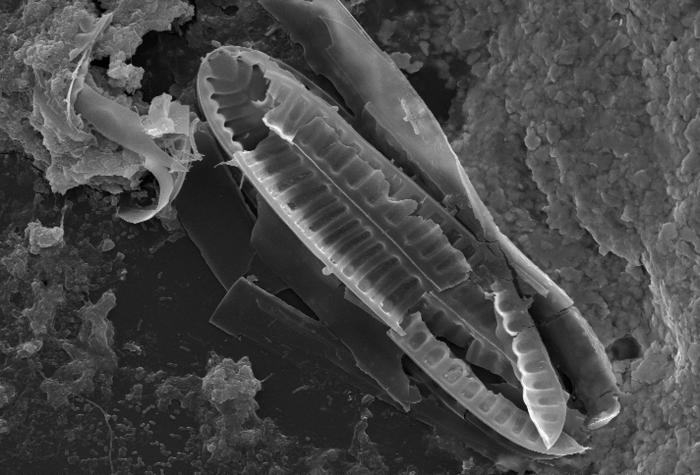

Mustard Algae (Diatoms) – Prevention and Cleanup
Responding to the EPA Sodium Bromide Ban
For Pool Pro Use Only: This guide is written specifically for professional pool service technicians. It assumes a working knowledge of algae identification, pool water chemistry, and treatment practices. If this isn’t you, this isn’t the place to start.
Introduction
The EPA’s ban on sodium bromide for outdoor pools removed a tool the industry had relied on for decades. But here’s the thing: what most pros call mustard algae is actually: diatoms (R. Stankowitz, June 2018). These silica-armored organisms thrive when the conditions align just right — sunlight, nutrients, silica, and the pool chemistry most of us use for plaster protection (higher pH and calcium hardness). Diatoms aren’t proof that you screwed up chemistry. They’re opportunists. They’ll take advantage of the smallest weakness in circulation or balance.
This guide is based on the research I’ve conducted on diatoms and cyanobacteria since 2018, combined with real-world field experience. I have intentionally kept the technobabble to a minimum. It’s designed to provide pool professionals with strategies that actually work, backed by data and tested in practice. [1][2][3][4].
Circulation and Dead Spots
Slow water is diatom heaven. Any corner, step, light niche, or bench with weak flow becomes a safe house. Chlorine drops off, biofilm thickens, and the diatoms dig in. Once they’re in a dead spot, they become established and begin to colonize. The fix is simple: move the water. Aim your returns to stir up those stagnant areas, and brush every inch where water gets lazy. Keep in mind that a pool in need of replaster offers hundreds, if not thousands, of nooks and crannies that serve as dead spots ripe for inhabiting – think of the surface of an English muffin. Improved flow reduces the number of surfaces where diatoms can establish themselves.
Available Treatment Tools
Chlorine is still the backbone. Keep it at 2–4 ppm in residential pools, and don’t hesitate to increase it when cleaning up an outbreak. Shock with liquid chlorine or Cal hypo as needed. Keep CYA below 50 ppm [2].
Polyquats are reliable, non-foaming algaecides. They rip up cell membranes and slow regrowth. They also play well with chlorine, copper, and borates [4].
Copper is one of the few things that can get through a diatom’s silica armor. It also inhibits photosynthesis by interrupting the Calvin cycle. Keep it at or below 0.3 ppm to lessen the possibility of stains. Copper only works right if pH and alkalinity are dialed in. Only use Chelated copper – it makes the job safer and steadier [4].
Borates at 30–50 ppm interfere with metabolism, buffer pH, sharpen clarity, and cut chlorine demand. They aren’t a quick kill, but they stick around as a long-term layer of protection [4].
Silver scrambles DNA and hangs around as long-term suppression, especially when paired with copper. Keep it between 0.01 and 0.1 ppm.
Zinc slows photosynthesis, usually shows up through anodes in salt systems, and can be dosed directly if needed. About 0.5 ppm gives you suppression without staining and adds corrosion protection. Used together with copper, borates, and polyquats, silver and zinc give you a layered defense [4].
Filtration and silica management often get overlooked. DE grids are a buffet line for diatoms and need regular cleaning. Sand and cartridge filters should be deep-cleaned, not just backwashed. If your fill water runs high in silica, dilution or pretreatment is worth considering [3]. YES – Silica test kits do exist!

What Diatoms Thrive On
Diatoms are photosynthetic and opportunistic. They’ll colonize surfaces and filters when the conditions line up:
- Light fuels growth, especially in shallow or sunny pools.
- Silica is required for shell formation and can come from fill water, DE media, or plaster dust.
- Phosphates and nitrates act as fertilizer.
- Rough plaster, grout, lights, and DE grids give them dead spots and surfaces to stick to.
- They thrive in typical pool operating temps (59–86 °F).
- They prefer pH at 7.5 or higher, which keeps silica more available.
- Calcium hardness above 277 ppm gives them better motility, since Ca²⁺ ions regulate the sticky EPS they secrete to glide across surfaces [1][3].
This is why you see diatom problems in pools that look “balanced” by plaster-protection standards.
Attack Plan During an Outbreak
Crank chlorine up to 10–15 ppm and hold it until the deposits fade [2]. Brushing is non-negotiable — that’s what breaks biofilm and exposes the colonies [1]. Add Polyquat by the book [4]. Dose copper carefully, never above 0.3 ppm, and stick with chelated products [4]. Add silver and zinc if you can, but stay inside the safe ranges [4]. Keep borates at 30–50 ppm [4]. Backwash or chemically clean filters as needed [3]. While treating, drop pH slightly to 7.2–7.4 and bring calcium hardness down closer to 200–250 ppm. Lower numbers slow their movement [1][3].
Why This Matters in Pools
Pools run at pH 7.5 or higher and calcium hardness above 277 ppm — numbers we often aim for to protect plaster — are actually prime conditions for diatoms if silica and nutrients are available. Add sunlight and circulation dead spots, and you’ve got a perfect setup for diatom growth. They don’t just hit surfaces. In DE filters, where silica is abundant and calcium is high, diatom films can grow right on the grids, choking flow and mimicking “dirty filter” problems.
Other Tools That Help
Enzymes break down oils and organics that shield diatoms [4]. Phosphate removers starve them [4]. Silica reduction through reverse osmosis or ion-exchange systems can make a big difference in high-silica areas [3]. Advanced oxidation processes — UV combined with ozone or peroxide — produce hydroxyl radicals that tear through biofilms [4]. MPS, or non-chlorine shock, doesn’t kill diatoms outright but clears the organics that protect them [4]. UV and ozone also add a secondary disinfection layer by damaging DNA and disrupting slime [4].
Field Reminder
A mustard algae (diatom) bloom doesn’t mean your chemistry program failed; it means there’s a weak spot. Address them by keeping sanitizer steady, using algistats (polyquats, borates), adding metals (copper, silver, zinc), brushing thoroughly, and cleaning filters. You don’t have to do everything—tackle what you can, and diatoms won’t stand a chance [1][2][3][4].
References
[1] Stankowitz, R. (2019). Swimming Pool Black Algae is Cyanobacteria. ResearchGate.
[2] Stankowitz, R. (2019). How to Prevent Swimming Pool Algae. Amazon Publishing.
[3] Stankowitz, R. (2020). Removal of Cyanuric Acid by Aluminum Cyanurate Complexation. ResearchGate.
[4] Stankowitz, R. (2019–present). Columns in AQUA Magazine and PoolPro Magazine addressing diatom control, cyanobacteria, and field-tested chemistry protocols.