

Managing a large aquatic facility at a university like the University of Houston Aquatics requires balancing the needs of multiple user groups while maintaining strict water quality, safety, and operational standards.
University aquatic centers often serve several roles simultaneously. They may support varsity athletics, recreational swimming, instructional programming, and community events, all within the same facility.
To better understand the operational challenges faced by collegiate aquatic programs, we spoke with Cara Green, Assistant Director of Aquatic Operations at the University of Houston. The University of Houston’s aquatic facility is consistently recognized among the top collegiate aquatic programs in the United States, making it an ideal case study for understanding modern aquatic facility management.
Green shared insights into the real-world challenges her team encounters while operating a large university natatorium.
Balancing Competitive Athletics and Recreational Use
One of the most common challenges at university aquatic facilities is balancing competitive athletics with recreational programming.
Collegiate swimming programs require significant lane space for daily training sessions, while recreation centers must also provide open swimming opportunities for students and campus community members.
Green explains that this balancing act is an ongoing operational challenge.
“Like many universities, we are constantly working to balance the needs of our varsity swim team with recreational programming and open swim opportunities for students.”
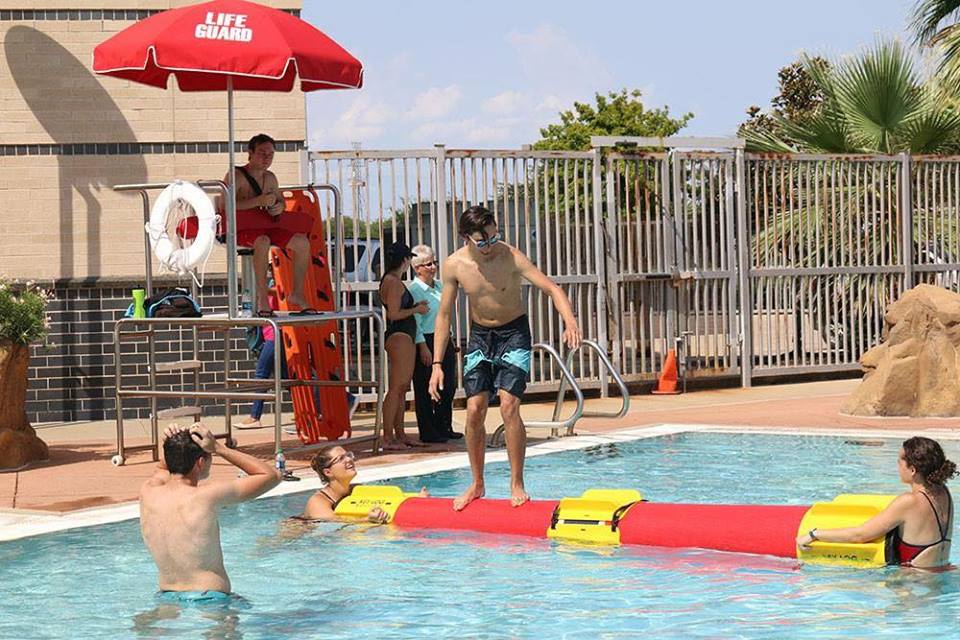
To address this issue, the University of Houston aquatics team has implemented a variety of creative programming initiatives designed to attract recreational users into the natatorium.
These programs include:
-
inflatable aquatic obstacle courses
-
recreational swim meets open to campus participants
-
instructional programs using floating training equipment
-
“dive-in” movie nights hosted inside the natatorium
These activities help encourage students who might not normally visit the facility to participate in aquatic recreation.
By introducing fun and engaging programming, the aquatics team has successfully increased participation and broadened the perception of the facility as a space available to the entire campus community.
Staffing Challenges in Aquatics Operations
Staffing lifeguards has become a widely recognized challenge across the aquatic industry.
Research from the American Lifeguard Association and other aquatic safety organizations has highlighted an ongoing shortage of certified lifeguards in many parts of the United States.
University recreation departments often face additional challenges due to the unique composition of student populations.
Green notes that the University of Houston’s diverse campus population brings unique considerations to lifeguard recruitment.
Because the university enrolls many international students, some candidates interested in lifeguarding may not yet have the swimming proficiency required to pass American Red Cross lifeguard certification prerequisites.
Even when qualified candidates are found and certified, retaining them can be difficult.
Local private pool companies and municipal recreation departments often compete for the same employees, sometimes offering higher wages.
To address this challenge, the University of Houston aquatics department has adopted several retention strategies.
These include offering discounted lifeguard certification courses in exchange for employment commitments and increasing hourly wages during peak summer months when demand for lifeguards is highest.
Additionally, the facility allows both students and non-students to work as lifeguards, expanding the available hiring pool.
Despite these efforts, staffing remains an ongoing challenge—one faced by aquatic facilities nationwide.
Facility Logistics: Unexpected Operational Challenges
While many operational challenges in aquatics relate to water quality and staffing, some issues are less obvious.
At the University of Houston, one of the most persistent operational concerns has been campus parking logistics.
The university recently adopted a zone-based parking system in which parking permits only allow access to specific areas of campus.
This created unexpected difficulties for staff members working at the recreation center, as parking permits purchased for academic buildings did not necessarily allow access to lots near the aquatic facility.
Green explains that the aquatics department continues to work with university parking services to find solutions that reduce frustration for student employees.
Operational logistics like these illustrate how aquatic facility management often involves factors beyond the pool itself.
Financial Sustainability in Aquatic Facilities
Budget management is another important component of operating a university aquatic facility.
Green jokes about the challenge:
“I used to say I worked at a pool because I was bad at math—but I had to get over that to be successful in this field.”
University aquatic programs often rely on a combination of program revenue, facility rentals, and event hosting to meet operational budgets.
At the University of Houston, revenue is generated through several channels, including:
-
contracts with local USA Swimming clubs
-
rental agreements for campus events
-
hosting competitive swim meets
However, regulatory changes can sometimes affect these revenue streams.
During the 2017–2018 swim season, the State of Texas introduced new requirements related to child protection training for adults participating in youth swim meets.
These new requirements required coaches, volunteers, and parents to complete additional training before being allowed on the pool deck during competitions.
Although the university offered free online training options, the additional administrative steps created challenges for swim clubs organizing competitions.
This demonstrates how regulatory changes—while often important for safety—can sometimes influence the operational logistics of aquatic events.
The Complexity of Modern Aquatic Facility Management
Operating a university natatorium requires expertise across multiple disciplines.
Aquatic professionals must balance:
-
facility scheduling
-
lifeguard staffing
-
equipment maintenance
-
regulatory compliance
-
programming and revenue generation
-
water quality management
Each aquatic facility presents its own unique operational challenges depending on factors such as facility design, user groups, and institutional policies.
Green emphasizes that successful aquatic programs depend on adaptability and collaboration across departments.
Why Professional Pool Operator Training Matters
Maintaining safe recreational water environments requires a strong understanding of water chemistry, filtration systems, disinfection methods, and aquatic facility regulations.
Many aquatic professionals responsible for operating swimming pools pursue Certified Pool Operator (CPO) certification, which provides formal training in recreational water safety and facility management.
Certified Pool Operator training covers essential topics including:
-
disinfection chemistry and chlorine management
-
filtration and circulation system operation
-
algae and biofilm prevention
-
health code compliance
-
chemical safety and risk management
Training programs such as the Certified Pool Operator (CPO) course offered through Aquatic Facility Training & Consultants help aquatic professionals develop the technical knowledge required to safely operate swimming pools in universities, hotels, recreation centers, and community facilities.
Learn more about Certified Pool Operator certification training here:
https://cpoclass.com/cpo-pool-operator-certification/
Frequently Asked Questions About Aquatic Facility Management
What are the biggest challenges in managing a university swimming pool?
Common challenges include scheduling conflicts between athletics and recreation programs, lifeguard staffing shortages, equipment maintenance, and balancing operational budgets.
Why is lifeguard staffing difficult for many aquatic facilities?
Many facilities face shortages due to competition for trained lifeguards and the physical requirements needed to pass certification prerequisites.
What training helps aquatic professionals operate pools safely?
Many aquatic professionals complete Certified Pool Operator (CPO) training, which teaches water chemistry, circulation system operation, and public health safety principles.
Who typically takes Certified Pool Operator classes?
CPO courses are commonly taken by pool service professionals, aquatic facility managers, recreation center staff, health inspectors, and hotel maintenance personnel.
Read More Swimming & Diving – University of Houston Athletics
Related Articles
Florida Southern College Aquatics
Understanding Biofilms and Black Algae in Swimming Pools
Preventing Chlorine Gas Exposure in Aquatic Facilities





















This is such an eye opener. Thankyou for bringing forth the thoughts and facts. It is very useful with my kids being passionate about swimming.
Thank you Seema & thank you for reading! It’s all about keeping swimming pools safe, healthy, and exciting… especially for the children ?
Wow! I had no idea that they were struggling to get qualified life guards. I like your idea of lowering the cost of the certification, or the University should refund it in full once/if they’re hired on as life guards.
Thank you for reading Linnea! Sadly, the lifeguard shortage is a nationwide epidemic. ☹
No idea this was happening. Definitely eye opening.
Thank you Diana & thank you for reading! Cara has definitely brought some things to light.